Ioulios Typaldos: A poet and judge in the Solomos circle
In “Oi gkionides”, two birds complain that everyone praises the nightingale while ignoring their own singing. They blame envy and decide to sing their own praises. Their author, Ioulios Typaldos, could be funny about vanity. He was also a poet, a judge and a close friend of Dionysios Solomos.
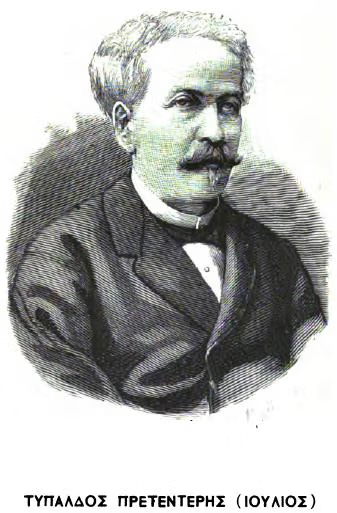
Ioulios Typaldos Pretenteris, 1882. Ioannes A. Arsenēs and Michael A. Raphaelobits. Via Wikimedia Commons. Source record. Public domain.
From Lixouri to the courts
Typaldos was born in Lixouri, Cephalonia, in 1814 and studied law in Italy. His judicial career took him across the Ionian Islands. He became president of the court in Zakynthos in 1852 and a member of the Supreme Council of Justice in Corfu in 1862.
He also wrote about legal matters and the Greek language. Poetry was one part of a working life that included substantial public responsibilities.
The poems and Solomos
In 1856, he published Poiimata diafora (Ποιήματα διάφορα, or Various Poems) in Zakynthos, dedicating the collection to Solomos. His poems drew on demotic Greek and folk song, with subjects including love, religious faith and the homeland. Andreas Kalvos’s twenty odes offer another Ionian treatment of national subjects.
The eight-line “Oi gkionides” has a different mood. Its birds are so certain of their talent that public indifference can only be someone else’s fault. The joke lands when they settle on self-praise as the remedy. Andreas Laskaratos’s dowry passage takes social criticism into the family’s treatment of a daughter.
Remembering his friend
After Solomos died in 1857, Typaldos delivered an address at a memorial service in the church of All Saints in Zakynthos. The speech was printed that year. Gerasimos Markoras and The Oath provide another route through the Corfiot circle.
Typaldos also translated work by Torquato Tasso and left unfinished tragedies. He died in Corfu in 1883. A later collection of his poetry, published in 1916, included a biographical account by Marinos Sigouros.
Further reading
- Ioulios Typaldos, “Oi gkionides”, in the official primary-school literary anthology.
- Iakovateios Public Library, Ioulios Typaldos: biography and bibliography.