Andreas Kalvos: The twenty odes and a life in exile
Andreas Kalvos published the twenty odes for which he is best known in two books: Lyra in Geneva in 1824 and Lyrika in Paris in 1826. He wrote about the Greek struggle for independence while living abroad, after years spent writing and teaching in Italian.
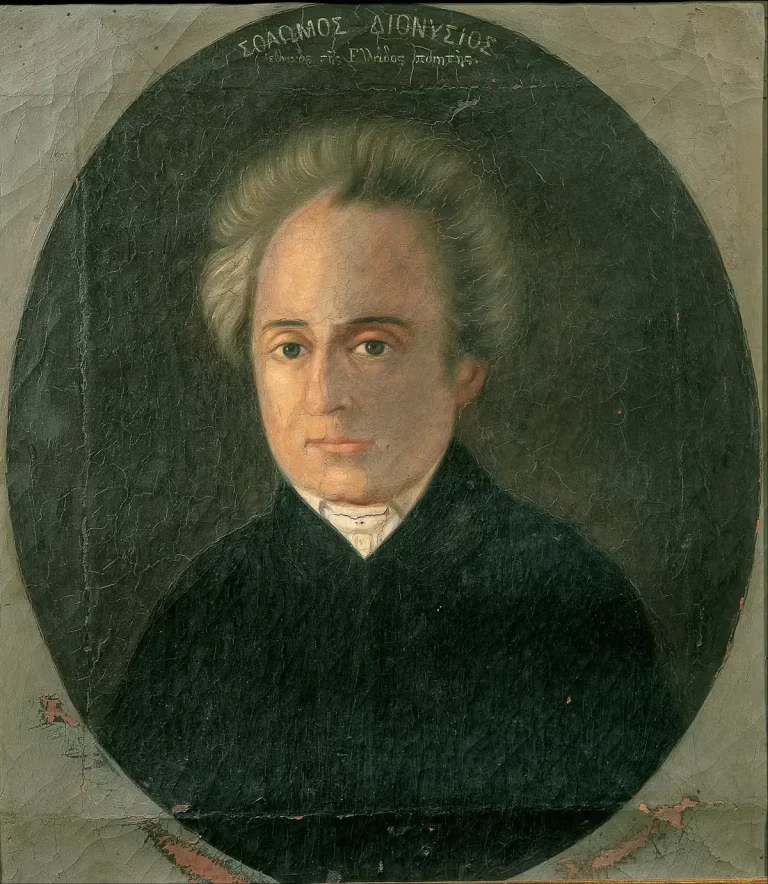
Andreas Kalvos, circa 1820. Unknown Italian painter. Via Wikimedia Commons. Source record. Public domain.
Zakynthos, Italy and London
Kalvos was born in Zakynthos in 1792 and left the island with his father as a child. In Italy he became close to Ugo Foscolo, following him to Switzerland and then London. The Capodistrias Museum’s biography records his Italian Ode agli Ionii of 1814 and the Greek ode Elpis patridos of 1819.
The twenty odes were therefore not all the poetry he wrote in Greek. The Centre for the Greek Language’s digital corpus includes the earlier ode as well as an untitled fragment, alongside the two familiar collections.
The opening of “Eis Pargan”
In “Eis Pargan”, included in Lyra, Kalvos begins by asking his lyre for a grave, elevated tone. Short lines carry the sentence across the stanza. Ancient gods and an eagle appear in the opening images, before the poem turns towards the fate of Parga.
The opening makes his register audible: formal address, learned vocabulary and a speaker preparing to praise a public act. It is a different manner from the conversational Greek of a folk song.
Teaching in Corfu
Kalvos reached Nafplio in 1826 and later settled in Corfu, where he taught at the Ionian Academy and worked in private education. Another Ionian poet in that Corfiot world is treated in Ioulios Typaldos: A poet and judge in the Solomos circle. He returned to England in 1852 and died in Louth, Lincolnshire, on 3 November 1869. In 1960 his remains, and those of his wife Charlotte, were brought from Keddington to Zakynthos; they rest in the mausoleum of the Museum of Solomos and Eminent Zakynthians, beside Dionysios Solomos. The two collections of odes belong to a brief period within this much longer life of teaching, travel and writing.
Further reading
- Centre for the Greek Language, Andreas Kalvos: scope and publication history of the digital corpus.
- Andreas Kalvos, “Eis Pargan”, official secondary-school textbook.