Santa Maura, 6–7 August 1684: Surrender, Handover, and the Move to Amaxiki
Francesco Morosini’s coalition fleet reached Santa Maura in July 1684, during Venice’s opening campaign in Greece. The fortress controlled Lefkada’s land entrance, routes towards the Adriatic and access to the Amvrakikos Gulf. Its surrender ended more than two centuries of Ottoman rule on the island. Venetian authorities then separated the military fortress from the island’s civilian and administrative centre.
Santa Maura’s strategic position
Venice needed a defensible base for its 1684 campaign in Greece. Santa Maura stood at Lefkada’s narrow connection with the mainland and controlled routes north to the Adriatic and east towards the Amvrakikos Gulf.
The Hellenic Ministry of Culture identifies the fortress as the land entrance to the island. Its position allowed a garrison to control movement between Lefkada, mainland Greece and nearby sea routes.
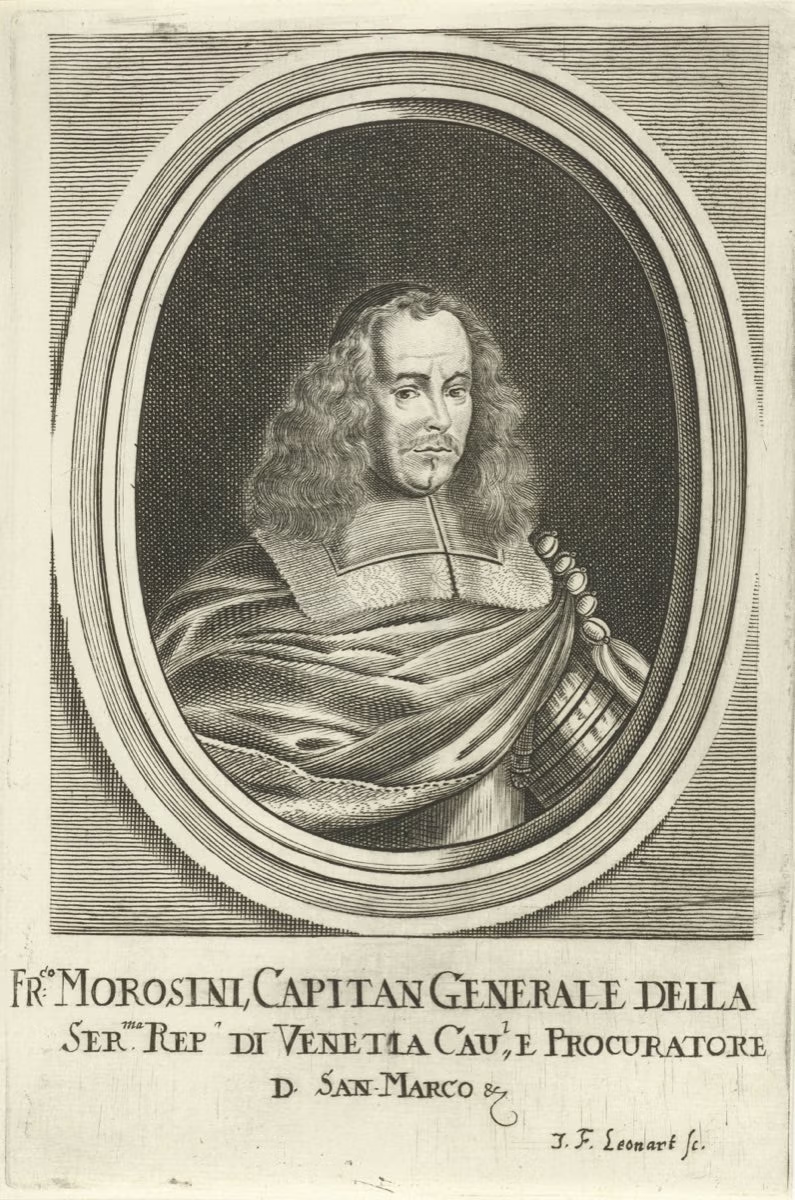
Morosini, captain-general at sea, commanded a coalition that included Venetian forces and contingents supplied by allies. Santa Maura became the first major Venetian conquest of the 1684 Greek campaign.
The war between the Ottoman Empire and the Holy League was already under way. Santa Maura gave Venice a forward position in the Ionian theatre from which its campaign could move south.
The siege from 20 July to 6 August
Morosini’s fleet appeared off Santa Maura on 20 July. Troops landed and began operations on the following day. An ultimatum was delivered on 22 July; when it was rejected, the bombardment began on the twenty-third.
The siege then tightened from land and water. Artillery damaged the defences, while trenches and batteries brought the besiegers closer to the walls.
Surviving accounts disagree over the exact size of the garrison, the identity or title of its commander and some of the losses on both sides.
By 27 July the attackers had opened a breach, and by the end of the month their works had advanced further. Disease and combat were already imposing costs. The defenders nevertheless continued to hold a fortress whose position made a direct assault dangerous.
On 6 August the Venetian coalition assaulted the fortress and was repulsed. Later that day, a white flag appeared, negotiations began and the defenders accepted surrender terms.
A white flag on 6 August, a handover on 7 August
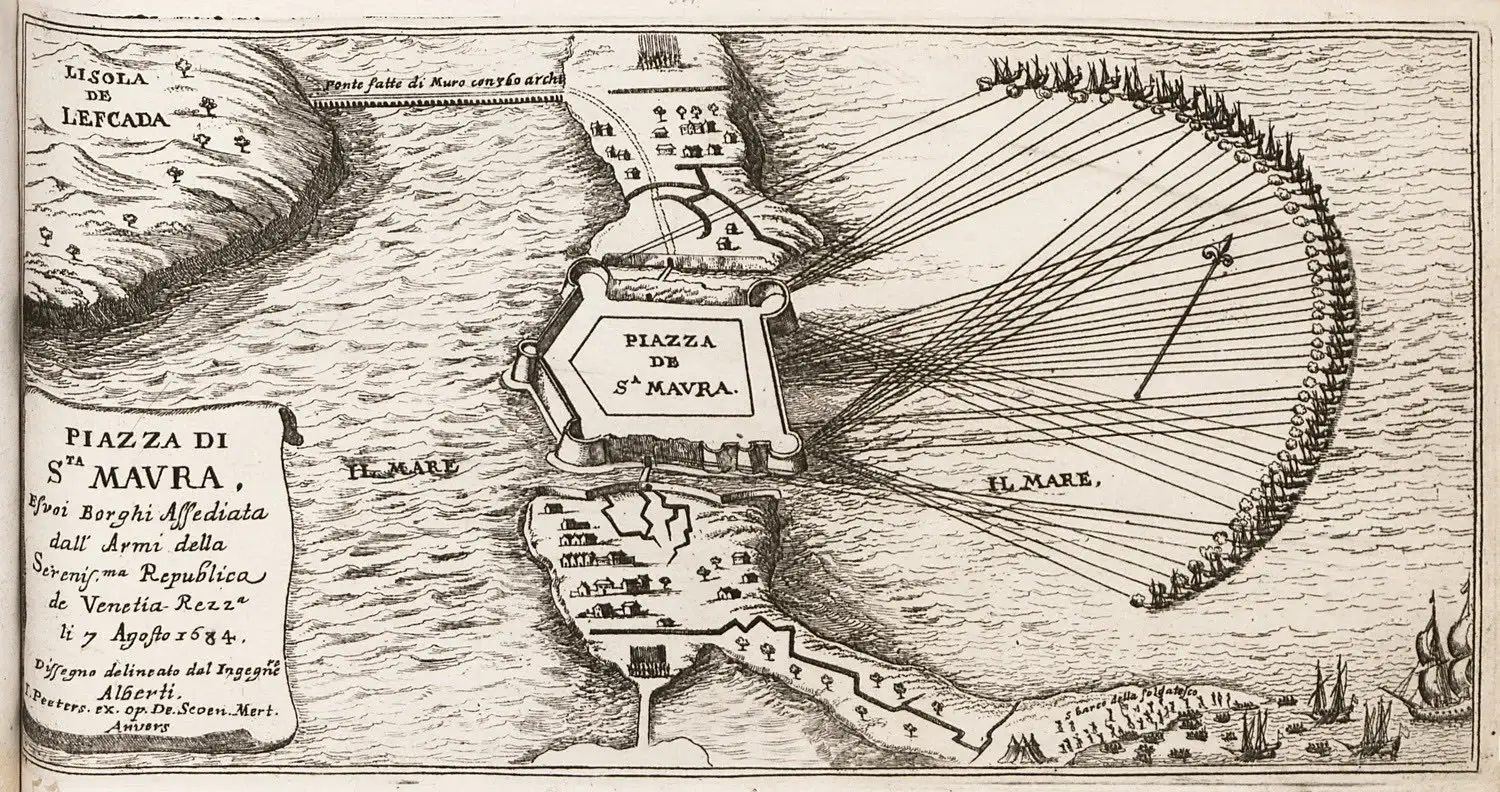
On 7 August, the garrison and thousands of civilians left the fortified settlement, and Venetian troops received the stronghold. A near-contemporary engraving by Jacob Peeters consequently labels the surrender with the seventh.
Many soldiers and civilians received safe passage towards Ottoman territory. The archival account examined by historian Vanessa Pinzelli also records that Christian captives taken from Ottoman service were compelled to serve for a year, while Black captives were retained as booty.
The surrender terms therefore combined safe passage with coercion and enslavement.
Amaxiki before and after 1684
Santa Maura contained houses, places of worship, stores and the institutions of an Ottoman town. After 1684, Venetian authorities cleared dwellings, converted or removed mosques, and reorganised the fortified zone for military use.
An Ottoman property record names Amaxiki in 1596. After the conquest, Venetian authorities transferred the island’s civilian and administrative centre there. Modern Lefkada Town developed around that existing settlement.
Venetian rule, 1684–1797
Venice had briefly possessed the island in 1502–1503 before returning it to the Ottoman Empire. After the conquest of 1684, Venetian administration lasted until the fall of the Republic in 1797, with a short Ottoman interruption in 1715–1716.
Santa Maura’s walls contain Frankish beginnings, major Ottoman enlargement, Venetian rebuilding and later British adaptations. Each new administration inherited and modified a defence system created over centuries.
The conquest left Santa Maura as a military stronghold while the civilian and administrative centre developed at Amaxiki.
Extended Read
The Hellenic Ministry of Culture’s guide to Santa Maura follows the fortress from its medieval beginnings through Ottoman, Venetian and British construction, and explains why its position controlled the land entrance to Lefkada.
Further Reading
- Vanessa Pinzelli, Venise et la Morée: du triomphe à la désillusion (1684–1718)
- Kenneth M. Setton, Venice, Austria, and the Turks in the Seventeenth Century
- University of Crete Press, introduction to Ottoman Lefkada
- Santa Maura Castle historical timeline
References
- Pinzelli, Vanessa. Venise et la Morée: du triomphe à la désillusion (1684–1718). Doctoral thesis, Aix-Marseille Université, 2013.
- Setton, Kenneth M. Venice, Austria, and the Turks in the Seventeenth Century. Philadelphia: American Philosophical Society, 1991.
- Hellenic Ministry of Culture. “Agia Mavra.” Castle Route. Accessed 6 August 2026.
- Municipality of Lefkada. “Historic References.” Accessed 6 August 2026.
- Treccani. “Francesco Morosini.” Dizionario Biografico degli Italiani.
- Mercure Galant. September 1684 issue.
- Peeters, Jacob. Piazza di Sta Maura. 1686. Public domain.
- Royal Collection Trust. “View of Lefkada and St Maura, 1684.” Research record; image not reproduced.
- University of Crete Press. Introduction to Ottoman sources for Lefkada.
- Leonard, Johann Friedrich. Portrait of Francesco Morosini. 1643–1680. Rijksmuseum, RP-P-1909-4521. Public domain.