Messolonghi bicentenary brings the Exodus archive into public view
“On 10 April 1826, the besieged decided to attempt a mass exit through the enemy lines.”
National Historical Museum account; translated by Othisis
Greece marked two hundred years since the Exodus of Messolonghi in 2026 with exhibitions, lectures, conferences and civic ceremonies. At the Chrysogelos Mansion, the National Historical Museum shows part of a press printed inside the besieged city, a plan of the garrison and lists of prisoners and the dead beside later paintings and prints.
What happened in April 1826
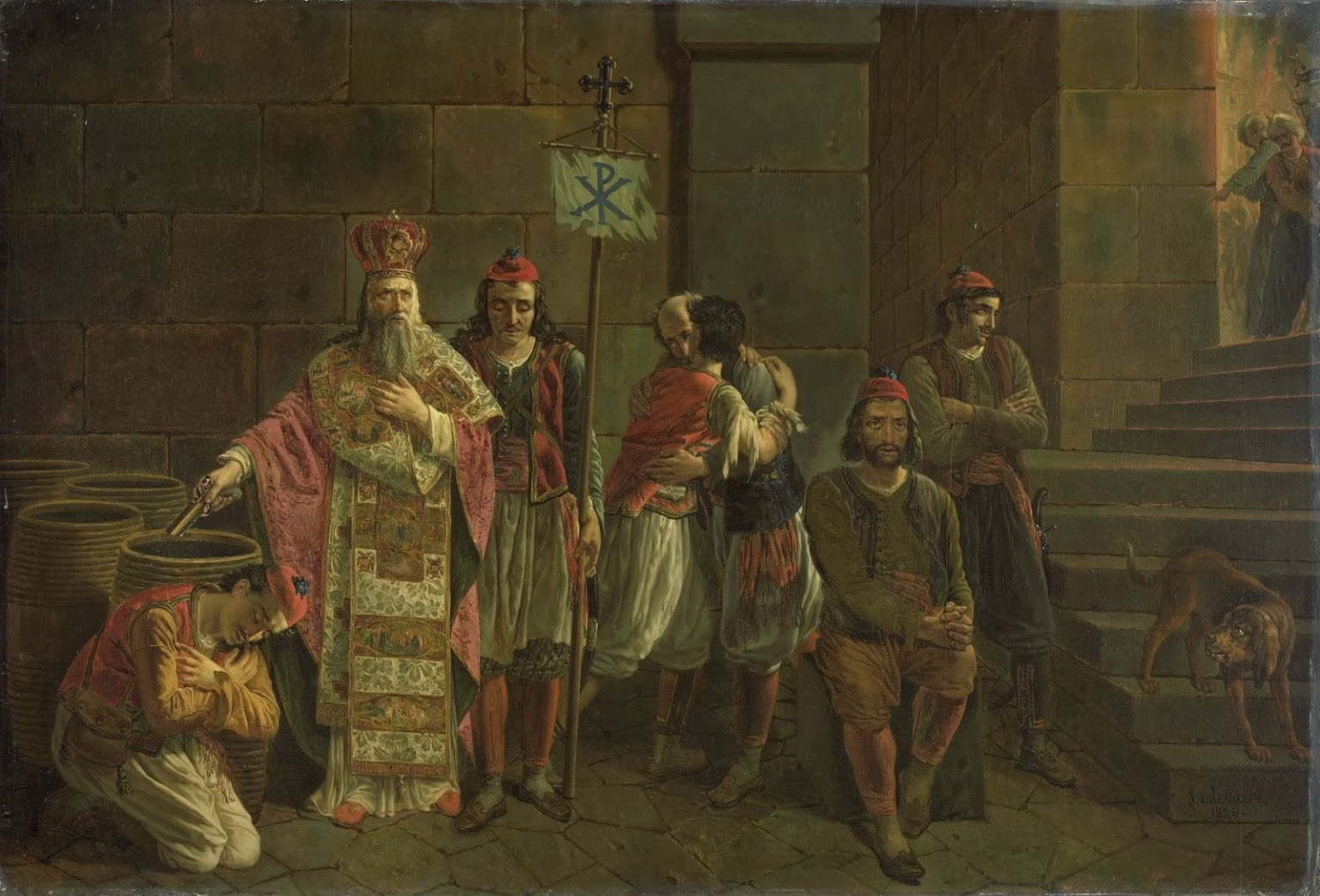
Messolonghi had endured the second siege for about a year when supplies failed and relief no longer appeared possible. The National Historical Museum records that the defenders decided on 10 April 1826 to attempt a mass exit through the besieging lines. Its collection title for a later lithograph gives the date as 10/22 April, preserving the old-style and new-style calendar forms used in records of the period.
The attempt brought severe losses, and the National Historical Museum states that many participants were killed. People who remained inside the city set fire to powder stores. A chronology published by the Hellenic Parliament Foundation places the fall on 11 April after a year-long siege by the forces of Reşid Mehmed Pasha, known in Greek as Kioutachis, and Ibrahim Pasha.
The state programme for 2026
The Municipality of the Sacred City of Messolonghi requested state support for the bicentenary. The Ministry of Culture placed the celebrations under its auspices and designated 2026 as the “Year of the Exodus of Messolonghi.” The Ministry announced it on 23 May 2025 and also funded selected municipal actions.
The Ministry’s central exhibition, “Messolonghi 1826–2026: In the Colours of Delacroix,” opened at the Xenokrateion Archaeological Museum. Eugène Delacroix’s Greece on the Ruins of Missolonghi travelled from the Musée des Beaux-Arts de Bordeaux for the occasion. Other loans included David d’Angers’s sculpture known as the Daughter of Greece and the surviving Sacred Band coat associated with Konstantinos Xenokratis.
A Messolonghi exhibition shows siege records beside later art
A second exhibition, “Exodus 1826–2026,” opened at the Chrysogelos Mansion in Messolonghi on 20 March and continues through 31 December. It was organised by the National Historical Museum with the Region of Western Greece. Its first part is divided into three sections: siege, exodus and memory.
The exhibits include part of the press on which the newspaper Ellinika Chronika was printed and the figurehead of Andreas Miaoulis’s ship Aris. Michael Kokkinis’s plan of the garrison appears with portraits of participants and lists of prisoners and the dead. Paintings and prints then show how later artists constructed public images of the siege.
A city commemorates itself
The municipality’s programme extends beyond museum exhibitions. In October, a four-day scholarly conference titled “200 Years since the Exodus of Messolonghi: History, Memory, Heritage” brought the municipality together with the National and Kapodistrian University of Athens and the University of Patras. Other events connected the anniversary to local traditions, music, education and the city’s established commemorative calendar.
The speeches and ceremonies show how the city and the state chose to remember the Exodus in 2026. The plan, the press and the lists in the Chrysogelos Mansion show what was there in 1826.
The exhibitions put dates beside documents and names
A military plan explains organised defence, while a press fragment points to the newspaper produced inside the besieged city. Lists restore names to categories such as prisoner and dead. Delacroix’s painting shows how the fall was translated into an image for a European public.
The Messolonghi exhibition runs at the Chrysogelos Mansion until 31 December 2026.
Featured image: Joseph Denis Odevaere, The last defenders of Messolonghi, 1826. Rijksmuseum, SK-A-1093. CC0. Wikimedia Commons.
Extended Read
Ioannis Zambelios: Preparing the Revolution from Lefkada.
Further Reading
- Ministry of Culture: 200 years since the Exodus of Messolonghi
- National Historical Museum: Exodus 1826–2026
- Hellenic Parliament Foundation: memoirs of the second siege
References
- Ministry of Culture. “200 χρόνια, από την Έξοδο του Μεσολογγίου (1826–2026),” 23 May 2025.
- National Historical Museum. “ΕΞΟΔΟΣ 1826-2026,” exhibition record, 20 March–31 December 2026.
- National Historical Museum. Messolonghi 1826, 2026 illustrated calendar, published 2025.
- Hellenic Parliament Foundation. Greek Revolution chronology, 1826–1833, and Artemios Michos memoir publication record.
- Municipality of the Sacred City of Messolonghi. “200 Years since the Exodus of Messolonghi: History, Memory, Heritage,” conference notice, 1–4 October 2026.
More from the journal
Lefkada: A Short Historical Chronology
Ancient Leukas, Santa Maura, Amaxiki and union with Greece
Aristotelis Valaoritis: Poet and Politician
His poetry, parliamentary record and unfinished Fotinos
The August Full Moon at Heritage Sites: A Western Greece Guide for 2026
Verified 2026 night openings and events at Nikopolis, Sami and Plevrona