Slow Travel Through Lefkada’s Working Traditions
Lefkada’s metal-clad upper storeys, Karsaniki embroidery and Faki Eglouvis reward close attention. Engineering studies, the national heritage inventory and the EU product specification explain what visitors can see and whom they should credit.
Slow travel concerns time, place and conduct
The EU CAP Network associates slow tourism with longer engagement, local culture and stronger connections with communities and the environment. A 2023 review by Anton Klarin and his co-authors places reduced pace, responsible discovery and lower-carbon travel patterns within the same field of research.
Environmental and community benefits depend on transport, length of stay and conduct as well as pace. Here, slow travel means spending enough time to understand a local process and the people who maintain it.
The structure behind Lefkada Town
Many older buildings in Lefkada Town were constructed with a dual load-bearing system developed in response to repeated earthquakes. Engineering studies describe stone masonry at ground level and an internal timber frame capable of carrying vertical loads if the ground-floor masonry is damaged. The upper floors use a three-dimensional wooden frame, diagonal bracing and brick-and-lime infill.
The system was empirical before it was codified. After the earthquake of 19 January 1825 nearly levelled Lefkada Town, the British administration introduced mandatory construction rules in 1827. According to Greece’s Earthquake Planning and Protection Organization, the code specified materials, wall thicknesses and building heights. Researchers studying the earthquake of 14 August 2003 found that the timber frames generally performed well even where masonry and infill were damaged.
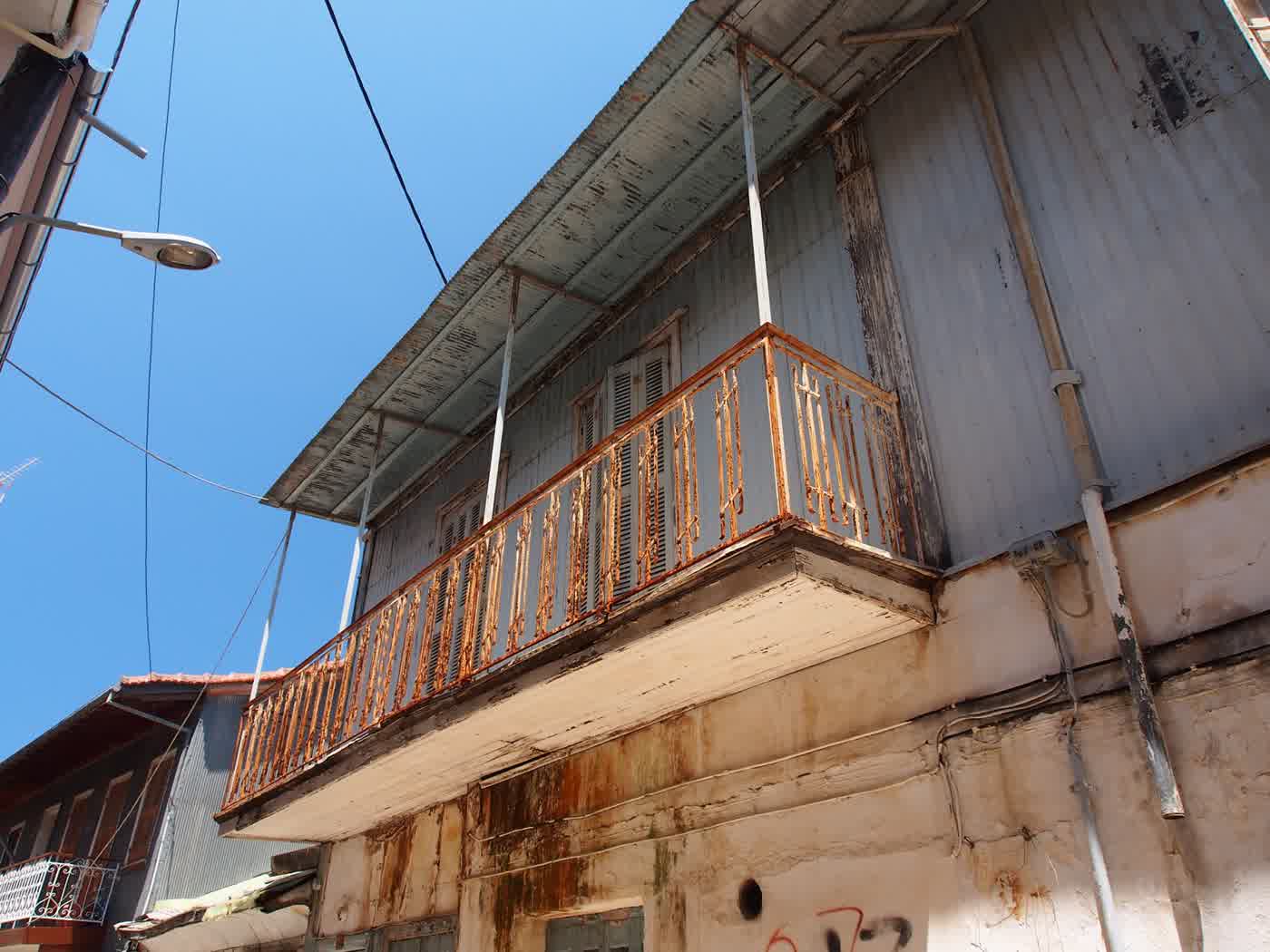
Metal sheeting on upper storeys is one visible feature of this construction tradition. It protects the timber and infill from weather and helps explain why parts of the old town differ from masonry settlements elsewhere in Greece. A façade can identify the tradition provisionally; concealed structure requires building-level evidence.
The same streets hold the birthplace of the poet Angelos Sikelianos, a two-storey house on Kyprou Street that the Municipality of Lefkada now runs as a museum.
Karsaniki embroidery belongs to Karya
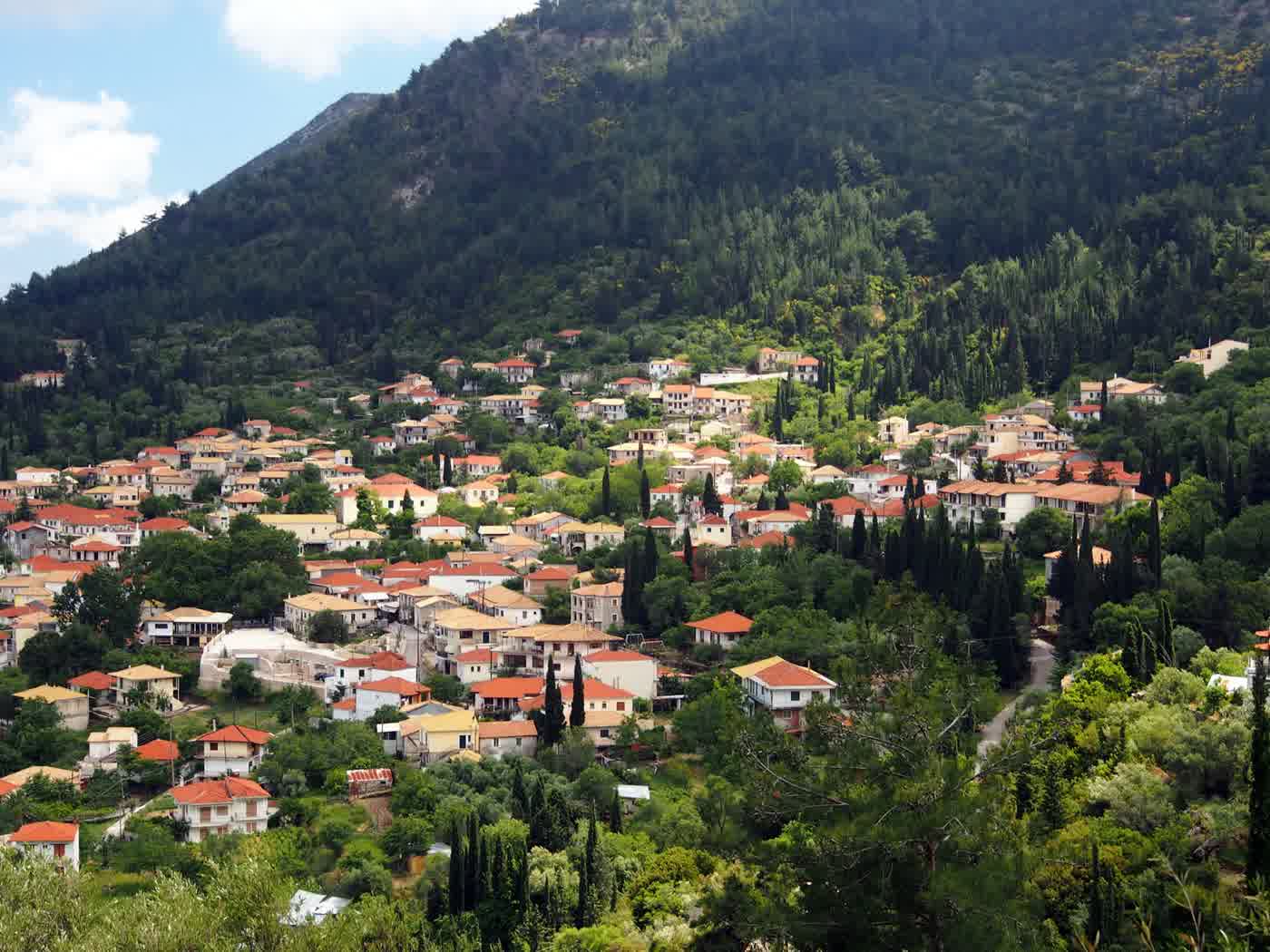
Karsaniki embroidery was entered in Greece’s National Inventory of Intangible Cultural Heritage in 2019. The record identifies Karya as its place of origin and Maria Stavraka, known as Koutsochero, as the creator of the technique. It is worked with a sewing needle and silk or cotton thread. The inventory emphasises the precision of its counted patterns.
The dossier attributes the technique to Maria Stavraka, who developed a way to secure the fabric and embroider after accidents had left her with one arm amputated and the other hand impaired. It also records organised teaching in Karya from 1912 and later transmission through Argyris Stavrakas and local households.
Seeing the work in progress, with a practitioner who has agreed to explain it, reveals the counted structure and time involved. Naming and crediting the practitioner preserves the information that makes the practice specific to Karya.
A protected crop in Englouvi
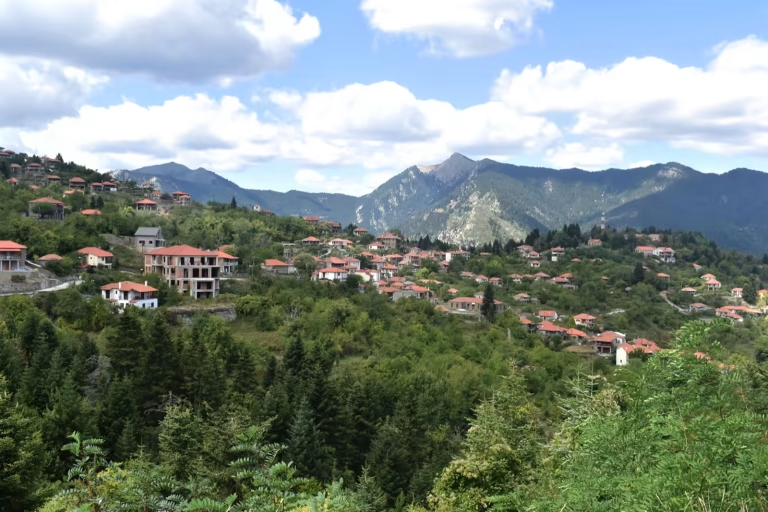
Faki Eglouvis, the lentil grown in the mountain community of Englouvi, entered the European Union register of Protected Designations of Origin in December 2023. The registration covers the local lentil population cultivated within the Englouvi municipal district.
The European Commission’s record gives the agricultural calendar: sowing begins in January and harvest takes place in June. Rain and west to north-west winds from mid-April to the end of May affect fertilisation and yield. The same record states that the crop has been cultivated in the area since at least the eighteenth century without admixture from other lentil varieties or populations.
The protected designation covers a landrace, a defined production area and a seasonal agricultural practice. A prepared dish may use the PDO name when it contains the genuine ingredient and follows the applicable labelling rules. A farmer or producer should be identified when their work appears.
Maria Stavraka and the Karsaniki stitch
The National Inventory dossier dates Maria Stavraka to approximately 1860–1948. It records that a childhood accident resulted in the amputation of her right arm at the elbow and that a second accident disabled her left hand. She devised a way to fasten the fabric to her clothing and hold it between her legs while embroidering with her impaired left hand. Through this work she developed the kafasovelonia, a technique described in the dossier as new among those then known.
The 1912 school linked an individual technique to organised teaching. The inventory also records a male embroiderer, Argyris Stavrakas, who learned the method after being disabled in the war of 1912. When the school closed in the 1930s, Maria continued working from home into old age. Following her death in 1948, Argyris taught dozens of young women, while the technique also passed within households.
The dossier predates its 2019 registration and records the history supplied for registration. Present-day arrangements for a visit, interview or workshop require direct confirmation from the community or the Municipality of Lefkada. The official National Inventory record documents the technique’s terminology.
Further Reading
- Karsaniki Embroidery, Karya, Lefkada, National Inventory of Intangible Cultural Heritage of Greece.
- 19 January 1825, Earthquake Planning and Protection Organization.
- Seismic response of traditional buildings of Lefkas Island, Greece, Engineering Structures.
- Faki Eglouvis PDO single document, Official Journal of the European Union.
- TikTok Next 2026, TikTok for Business.
References
- TikTok for Business. TikTok Next 2026 Trend Report. Accessed 29 July 2026.
- EU CAP Network. Slow Trips transnational cooperation project. Accessed 29 July 2026.
- Klarin, Anton, Eerang Park, Qijie Xiao and Sangkyun Kim. “Time to transform the way we travel? A conceptual framework for slow tourism and travel research.” Tourism Management Perspectives 46 (2023): 101100.
- Earthquake Planning and Protection Organization. “19 January 1825.” Accessed 29 July 2026.
- Makarios, T. K. and M. Demosthenous. “Seismic response of traditional buildings of Lefkas Island, Greece.” Engineering Structures 28, no. 2 (2006): 264–278.
- National Inventory of Intangible Cultural Heritage of Greece. Karsaniki Embroidery, Karya, Lefkada. Dossier prepared 2018; registered 2019. Accessed 29 July 2026.
- European Commission. “Publication of an application for registration of a name: Faki Eglouvis.” Official Journal of the European Union C 306 (30 August 2023): 27–31.
- European Commission. Commission Implementing Regulation (EU) 2023/2893 entering Faki Eglouvis in the PDO register. 15 December 2023.
- European Commission. “Guidelines on the labelling of foodstuffs using protected designations of origin or protected geographical indications as ingredients.” Official Journal of the European Union C 341 (16 December 2010): 3–7.