INSETE 2026 study: Greek tourism receipts rose in 2025 while stays shortened
«Χρειάζεται, με άλλα λόγια, να περάσουμε από το περισσότερο στο ουσιαστικό.» In other words, we need to move from more to the substantial. English translation by Othisis.
Agapi Smbokou, President of SETE, in INSETE, Ο Ελληνικός Τουρισμός: Επιτεύγματα, Προκλήσεις, Προοπτικές (2026), p. 7
Greece’s 2025 tourism season set new highs: 37.98 million inbound arrivals excluding cruise (+5.6% versus 2024) and €22.6 billion in travel receipts (+9.8%), according to INSETE’s 2026 study. Average length of stay still fell to 6.1 nights from 7.4 in 2019. In the Ionian Islands, receipts fell 4.1% despite more visits. SETE President Agapi Smbokou names the task that follows: move from more to the substantial.
Key figures from the INSETE 2026 study
These are the study’s headline numbers for 2025 (ex-cruise unless noted), drawn from Bank of Greece and ELSTAT series processed by INSETE Intelligence (pp. 14, 27).
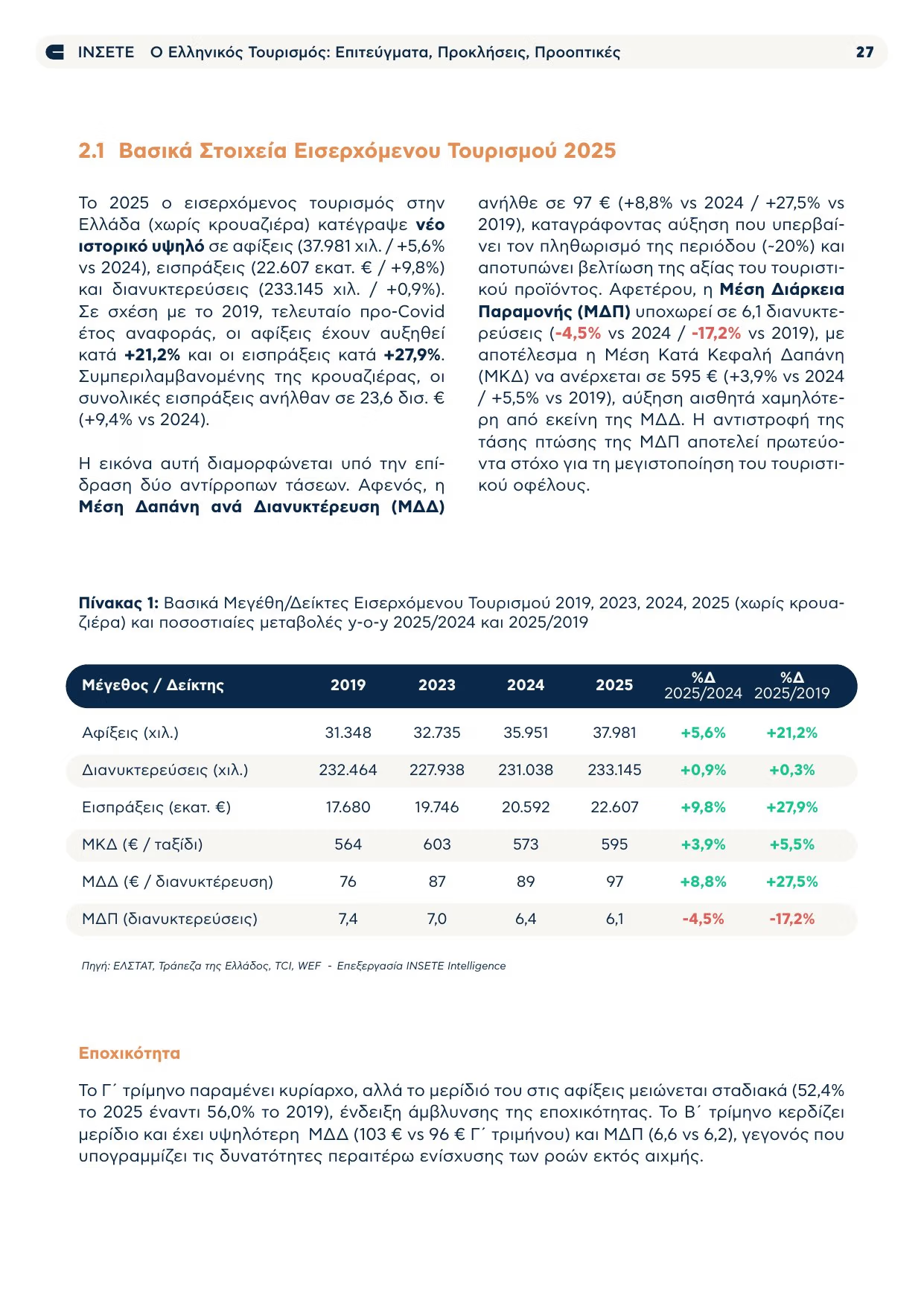
- Arrivals 2025: 37.98 million inbound (+5.6% versus 2024; +21.2% versus 2019).
- Receipts 2025: €22.6 billion (+9.8% versus 2024; +27.9% versus 2019); €23.6 billion including cruise.
- Stay and spend 2025: average stay 6.1 nights (from 7.4 in 2019); spend per night €97; spend per trip €595.
- Economy 2025: direct tourism contribution 13.0% of GDP; peak employment 475,000 in accommodation and food in the third quarter of 2025.
- Ionian Islands 2025: receipts -4.1% despite more visits (Crete -5.0% on the same pattern).
- Brand 2024-2025: visitor experience 9.1/10; WEF tourism rank 21st (+38 places versus the general economy).
What 2025 delivered on volume and spend
INSETE (the Institute of the Greek Tourism Confederation) published Ο Ελληνικός Τουρισμός: Επιτεύγματα, Προκλήσεις, Προοπτικές, by Aris Ikkos and Evangelia Lamprou (2026). The study synthesises the 2025 season. Excluding cruise, overnights reached 233.1 million (+0.9% versus 2024). Cruise added 5.33 million arrivals and about €1.0 billion in receipts. Spend per night rose faster than period inflation of about 20%, while the stay compression kept spend per trip growth modest (INSETE 2026, pp. 14, 27).
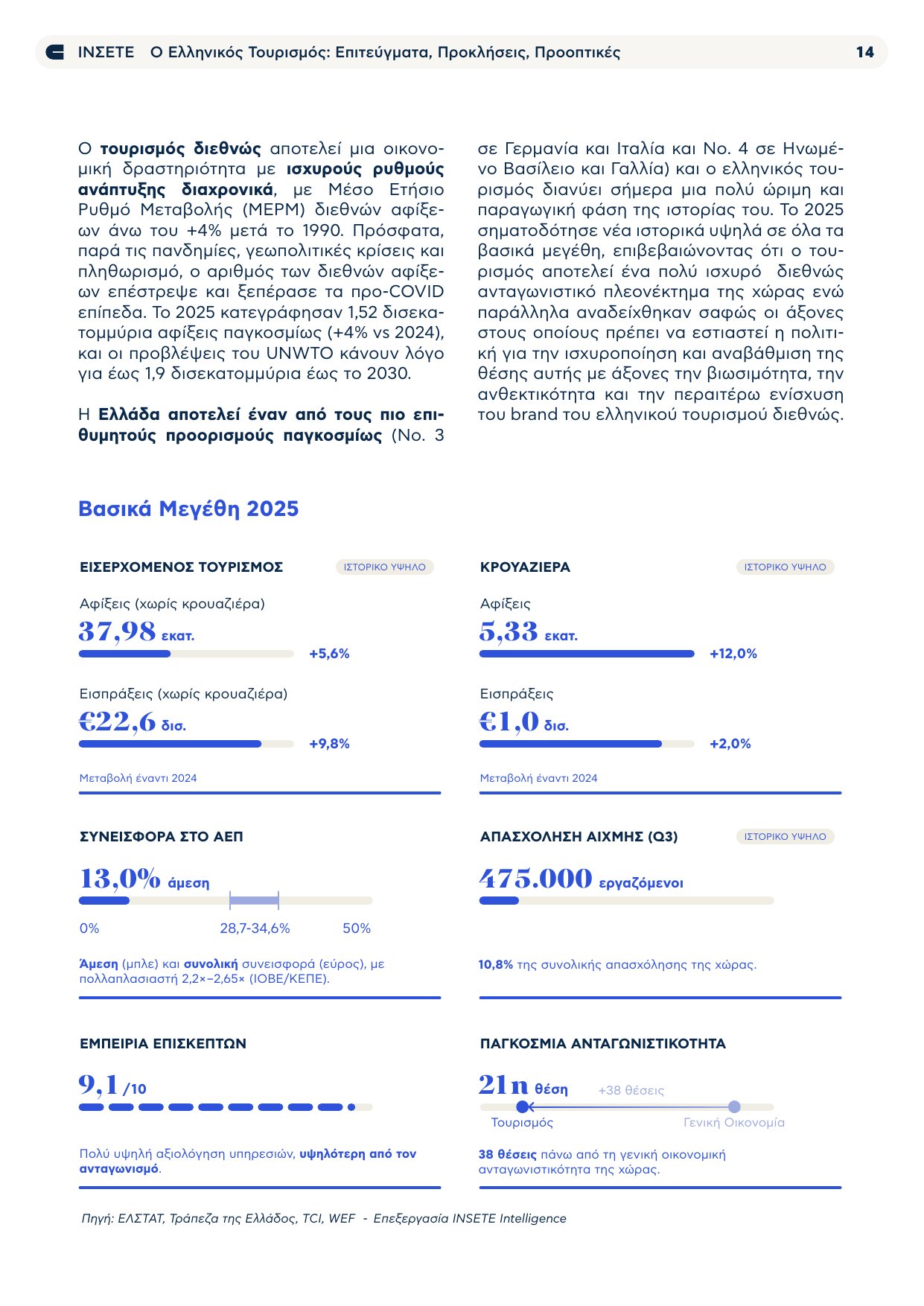
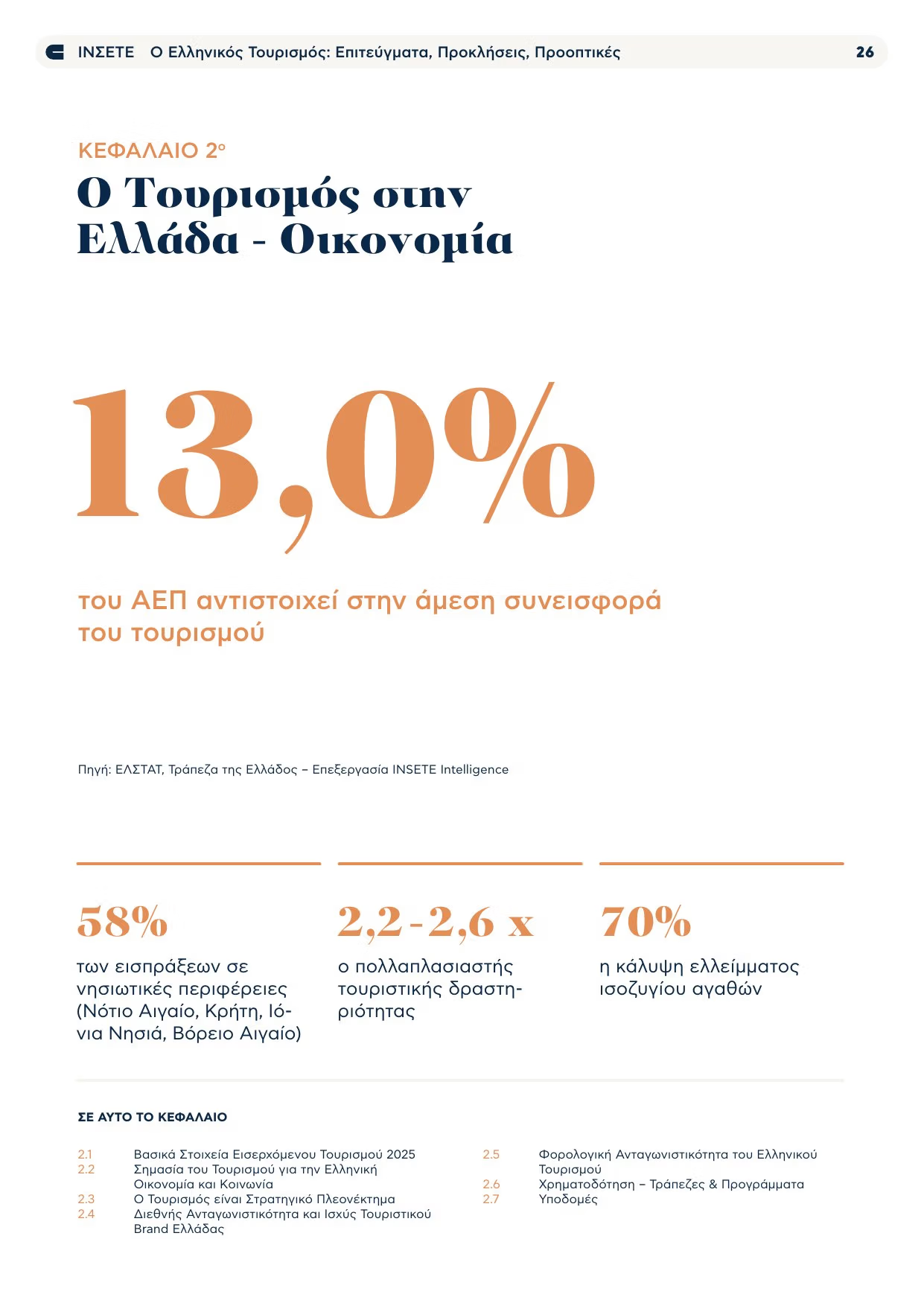
Direct tourism contribution stood at €32.4 billion, or 13.0% of GDP (from 12.8% in 2024). With multipliers of 2.2 to 2.65 times, total contribution sits between €71.3 and €85.9 billion, or 28.7% to 34.6% of GDP. Travel receipts covered 69.9% of the goods trade deficit, and about 81.3% when air transport and cruise are included. Island regions (South Aegean, Crete, Ionian Islands, North Aegean) took 58% of receipts. Five developed regions (Attica, South Aegean, Crete, Central Macedonia, Ionian Islands) together held 83% of visits and 90% of receipts (INSETE 2026, pp. 26, 28).
Shorter stays, and the Ionian receipts drop in 2025
The strategic tension sits in duration. Average length of stay fell from 7.4 nights in 2019 to 6.1 in 2025 (-4.5% versus 2024; -17.2% versus 2019). Nightly spend rose over the same period, so national receipts still climbed, but the stay compression is the measure Smbokou’s “substantial” agenda has to reverse (INSETE 2026, Table 1, p. 27).
Regionally the trade-off is already visible. Attica led growth in 2025 (+10.5% visits; +22.9% receipts versus 2024). The South Aegean remained first in receipts (€6.625 billion). Crete and the Ionian Islands recorded receipt declines of 5.0% and 4.1% respectively despite more visits, which INSETE attributes to falls in average length of stay and spend per night (INSETE 2026, p. 28).
That Ionian pattern matches the question Othisis has tracked through airport and capacity evidence: growth that does not lift regional receipts is not prosperity. See Tourism Beyond Volume: Evidence Standards for This Series and July 2026 at the Ionian Gateways: Growth Was Uneven.
Concentration, not national saturation
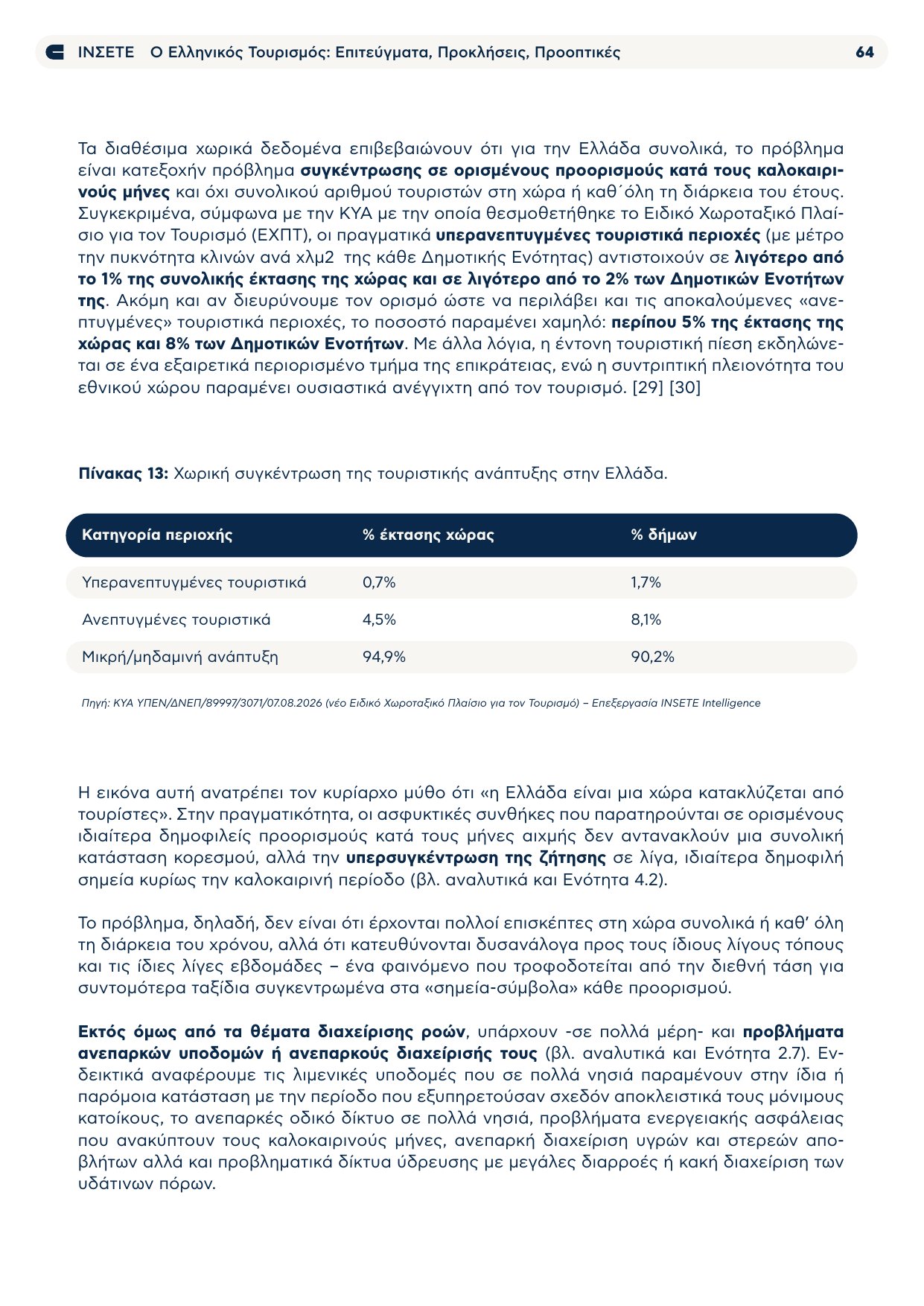
On spatial development, Table 13 of the study (drawing on the Special Spatial Framework for Tourism decision of 7 August 2026) classifies overdeveloped tourism areas as 0.7% of land and 1.7% of municipalities; developed areas as 4.5% and 8.1%; and small or negligible development as 94.9% and 90.2%. Eight of thirteen regions hold only about 10% of tourism revenue. Five islands (Crete, Rhodes, Kos, Corfu, Zakynthos) take 47% of international arrivals. Main island destinations including the Ionian take more than 70% of international air arrivals in June to September 2025 (INSETE 2026, pp. 64, 66).
Beach-adjacent four- and five-star hotels number 608 nationwide, with 110.5 km of coastline in front of them, or 0.6% of the national coastline. In the Ionian Islands the study counts 86 such hotels and 15,446 m of frontage, or 1.2% of the regional coastline (second only to Crete at 2.1%), with 42% of that frontage rocky (INSETE 2026, pp. 67-70). The pressure is extreme concentration in a few places and weeks across a country that remains mostly lightly developed for tourism.
Seasonality easing, certifications still thin
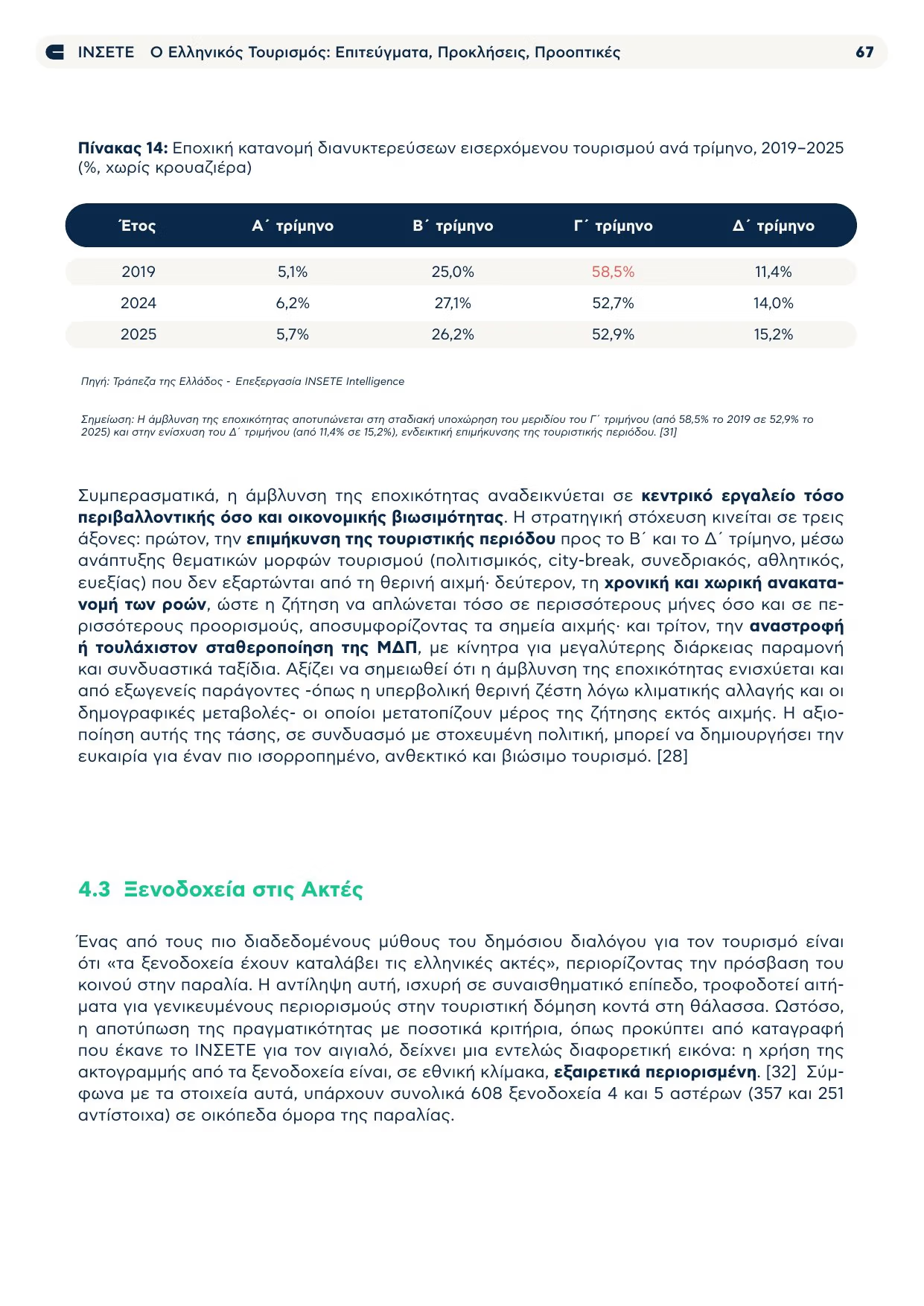
Seasonality is easing from a high base. The third-quarter share of inbound overnights fell from 58.5% in 2019 to 52.9% in 2025; the fourth-quarter share rose from 11.4% to 15.2% (Table 14, p. 67). The third-quarter share of arrivals fell from 56.0% in 2019 to 52.4% in 2025. That shift matters for island economies that still pack most international air traffic into June to September 2025.
Sustainability certification remains sparse: about 8% of hotels hold a certification, and 73% of firms have no 2030 emissions-cut target despite a legal -30% versus 2019 requirement. As of April 2026, about 801 properties were certified, with Green Key and Travelife covering roughly 91% of active certifications. The Ionian Islands had 74 certified hotels among 1,024 units, or 9.2% of the national certified stock (Table 19, p. 77). Blue Flags in the Ionian fell from 48 in 2023 to 46 in 2024 and 42 in 2025, at a density of 3.1 per 100 km, while Greece’s national total rose to 623 beaches (Table 20, p. 78).
Brand strength beside social friction
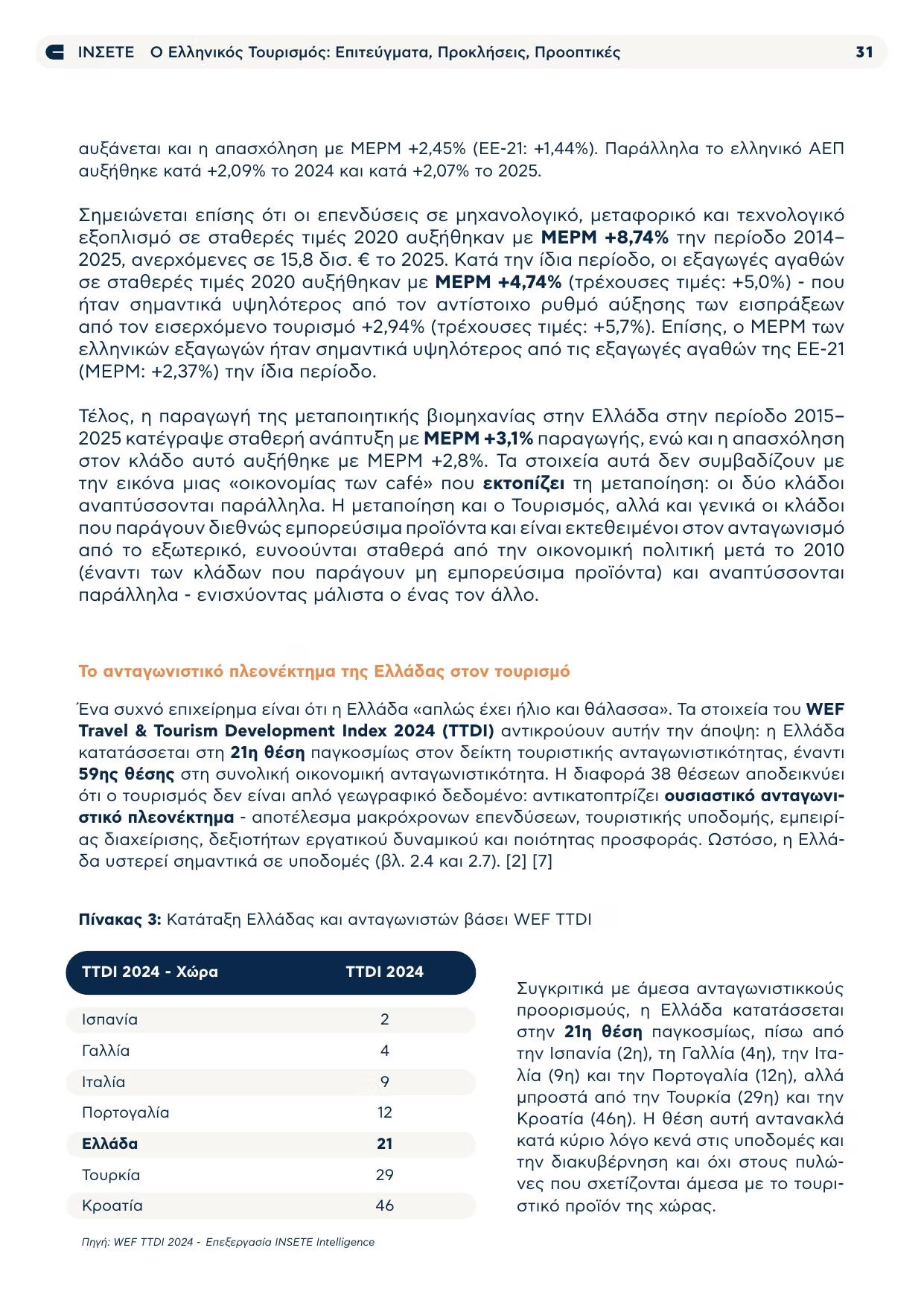
Visitor experience scored 9.1 out of 10 on TCI research, with Net Promoter Score 54 (+3 versus 2024). On the World Economic Forum Travel and Tourism Development Index 2024, Greece ranked 21st for tourism against 59th for the general economy, a gap of 38 places. Peer tourism ranks in the same index: Spain 2, France 4, Italy 9, Portugal 12, Turkey 29, Croatia 46 (Table 3, p. 31). Preference surveys (GWI 2025) placed Greece third as a desired destination in Germany and Italy, and fourth in the United Kingdom and France.
Domestic opinion is split. Fifty-four percent of Greeks named tourism the sector with the greatest progress from 1974 to 2024 (Prorata). Net satisfaction indices were strongly positive for Economy (+72.1), Jobs (+57.8) and Culture (+43.4), and strongly negative for Rents (-66.0), Environmental pollution (-49.0) and Cost of living (-46.4) (INSETE 2026, pp. 50-53). On overtourism, 30.5% said Greece already has it, 45.6% said it is at risk, and 19.6% preferred more tourists (p. 63). The social licence and the brand score point in different directions; both belong in any “substantial” agenda.
What the Ionian numbers imply for Lefkada
The INSETE 2026 study does not name Lefkada as a standalone case. Every local reading below is an implication from the Ionian Islands region figures the study does publish. None of it is a Lefkada measurement.
The Ionian Islands sit inside the five developed regions that take 83% of visits and 90% of receipts, and inside the four island regions that take 58% of national receipts (INSETE 2026, pp. 26, 28). Corfu and Zakynthos are named among the five islands that receive 47% of international arrivals (p. 66). Lefkada belongs to that same regional system of peak-season air and sea pressure, even though the study never isolates it.
The Ionian receipt drop of 4.1% in 2025 despite more visits is therefore the verified local stress test: volume rose while regional yield fell through shorter stays and lower spend per night (p. 28). Beach-adjacent four- and five-star frontage in the Ionian is 15,446 m, or 1.2% of regional coastline, with 42% of that frontage rocky (pp. 67-70). Certified hotels number 74 of 1,024 units (9.2% of the national certified stock), and Blue Flags in the Ionian fell from 48 in 2023 to 42 in 2025 while the national total rose (Tables 19-20, pp. 77-78). Those are regional facts. They frame Lefkadian prosperity questions about length of stay, shoulder seasons, and certification density without inventing island-level series the study does not contain.
What “substantial” requires next
INSETE’s challenges chapter (pp. 80-98) covers destination management and DMMOs, spatial and temporal diffusion, and staffing. About 14% of hotel posts were vacant in 2025, and only 24% of hotel staff came from tourism schools. Further items include tax and fee competitiveness, public infrastructure, EXPT implementation, short-term rental sprawl, METRON Sustainable Tourism, data gaps, product enrichment, climate, and Asian market development.
Kikilias’ preface states that the quality of decisions depends on the quality of the knowledge they rest on (p. 9). The economy chapter puts the productivity question plainly: tourism is Greece’s strongest internationally competitive advantage; the question is how to raise productivity in and around it, not how to shrink it (p. 32).
The takeaway is narrow. National 2025 highs on arrivals and receipts do not settle the Ionian yield problem, and Lefkada cannot be read out of a study that never names it. Longer stays, higher nightly yield where it has slipped, the shoulder-season share already rising in the national quarters, and certification density that still covers under a tenth of Ionian hotel stock are the concrete tests of Smbokou’s line on page 7: from more to the substantial.
Featured image: Ag. Nikolaos, Fokida. Photo: Georgios Kouvaris.
Read more
Continue with Tourism Beyond Volume: Evidence Standards for This Series.
Further Reading
- INSETE study page: Greek Tourism: Achievements, Challenges, Prospects
- INSETE press release, 23 October 2026
- Local Capacity Sets Tourism’s Limits
- Greece’s Tourism Plans Face the Local Delivery Test
References
- Ikkos, A. and Lamprou, E. (2026). Ο Ελληνικός Τουρισμός: Επιτεύγματα, Προκλήσεις, Προοπτικές. Athens: INSETE. Available at https://insete.gr/studies/greek-tourism-achievements-2025/ (accessed 30 October 2026).
- INSETE (2026). Press release on the study presentation, 23 October 2026. Available at https://insete.gr/blog_news/intel-261023-pr/.