Lošinj Kept Its Hotels Open Longer: A Plan for Lefkada Town, Karya and Nydri
In July and August 2024, the hotels of Mali Lošinj took 42 per cent of their year’s guest nights; the town’s camps and private rooms took 64 per cent of theirs. That gap, recorded in the town’s draft destination plan for 2026 to 2029, holds the island’s lesson for Lefkada. Lošinj did not fill its quiet months by selling winter. In 1892, its climate earned it state health-resort status. Upscale hotels followed that status; they open longer and spread their nights across the year far better than rooms or camps.
The Lefkada version Othisis proposes here would mean fewer cheap beds and three year-round anchors: Lefkada Town as the service and wellbeing base, Karya as the craft stay, and Nydri as the sheltered-water base. On Lošinj’s evidence, that would lengthen the season at both ends. It would not create a winter one.
Lošinj’s hotels lean less on July and August
The Institute for Tourism in Zagreb prepared the plan, which covers 2026 to 2029, for the Mali Lošinj Tourist Board. The version on the town’s website, dated April 2026, is marked as a working draft, so its figures may change. Its seasonality figures come from eVisitor, Croatia’s guest-registration system. Across the town in 2024, 58 per cent of all commercial nights fell in July and August. Hotels sat well below that average at 42 per cent; camps and private accommodation sat above it, at 64 per cent each.
The wider summer shows the same split. From June to September, camps took 87 per cent of their nights and private rooms 90 per cent, against 68 per cent for hotels. Hotel occupancy in 2024 ran from 16 per cent in January to 43 per cent in March, and between 29 and 41 per cent from October to December. Camps recorded 2 to 3 per cent in January and February.
Almost all of those hotel beds are upscale. Four-star hotels hold 76 per cent of them and five-star hotels 19 per cent, about 95 per cent together. Hotels were also the part of the market that grew: between 2022 and 2024 hotel nights rose 13.9 per cent, while camp nights fell 5 per cent and private-accommodation nights 5.4 per cent. They remain a minority of the town’s capacity, with about 3,200 of roughly 19,300 beds in hotels, camps and private rooms, and 22 per cent of all nights. Their weight lies in when those nights fall.
From climatic health resort to upscale hotels
The plan traces those hotels to a climate record. Measurements by Ambroz Haračić, with research by the Austrian specialists Conrad Clar and Leopold Schrötter, led to the designation of Veli Lošinj and Mali Lošinj as state climatic health resorts in 1892. Sanatoria, convalescent homes, hotels, guesthouses and villas followed. In the twentieth century the same climate was the basis for a children’s hospital for allergic diseases in Veli Lošinj, which at times treated up to 400 patients a day and employed 190 staff.
The largest operator today, Jadranka turizam, runs three four-star hotels with 1,161 units and three five-star hotels with 265 units in the town, alongside its camps. The health record has become a hotel product. Bellevue, a five-star hotel on Čikat Bay, hosted the first MEDISOLA festival of health and vitality from 2 to 26 October 2025. It opened with a conference on the island’s healing tradition and continued with themed weekends on medicine, nutrition, spa treatment and outdoor activity. The 2026 edition is listed for the whole of October.
Dalibor Cvitković, director of the Mali Lošinj Tourist Board, used that opening conference to put a number on winter. According to the tourist board’s report, he said the island could take about 2,000 guests in winter with 10 per cent of its capacity open, and that the board was working to fill it. In an interview with Turizam.media the same month, he described the pre-season as built on outdoor events and congresses, and the post-season on food, culture, health and wellbeing. Hotels and camps that had invested in quality, he said, were doing better despite higher prices.
Over the New Year that opened 2026, the tourist board counted a record 4,648 guests and 17,128 nights between 29 December and 1 January. Bellevue, Vitality Hotel Punta in Veli Lošinj and Čikat camp were open to individual guests; two further hotels, Aurora and Vespera, took closed groups. Hotels hosted 2,284 of those guests and the camp 1,888.
Lošinj still earns 58 per cent of its nights in July and August
None of this makes Lošinj a winter destination, and the plan does not claim it. Even with its hotels, the town still earned 58 per cent of its nights in two summer months, and hotels earned 93 per cent of their annual nights between March and October. The Institute’s TOMAS survey for 2025 and 2026, cited in the plan as preliminary, found sun and sea to be the main motive for 73 per cent of visitors and nature for 24 per cent. Health tourism was the main motive for about 1 per cent, and wellness for less than 1 per cent.
The winter offer is small. The tourist board’s own listing gives Bellevue an operating season of March to November, so its New Year opening is an exception to that calendar, not evidence of a hotel that never closes. Of the 28 restaurants the board counted in the plan, 5 trade all year.
The car ferries from Valbiska and Brestova run all year, but the Zadar line drops to two sailings a week in winter. Cvitković’s 10 per cent describes the scale accurately. Lošinj extended its season at both ends and keeps a small core open through the winter. It did not create a winter season, and Lefkada should not expect the same method to create one.
Lefkada’s bed mix
Lefkada starts from the other end of the scale. The Hellenic Chamber of Hotels’ 2025 register, processed by its research institute ITEP, lists 107 hotels with 6,221 beds in the Lefkada regional unit, which includes Meganisi. Five-star hotels hold 504 of those beds and four-star hotels 919, together 23 per cent. Two-star hotels hold 2,590 beds, or 42 per cent. On Lošinj the upscale share of hotel beds is about 95 per cent.
Both figures cover hotels only. Lefkada’s rooms to let and villas sit outside the hotel register, and Lošinj’s hotels are themselves a minority of its beds. The comparison shows the bed mix of hotels, the sector that carried Lošinj’s season furthest from August.
The regional figures add a second problem. INSETE’s 2024 summary of international tourism in the Ionian Islands shows visits up 2 per cent and spending per night up from €76 to €80. Total nights, however, fell 8 per cent, from 26.9 million to 24.7 million; the average stay shortened from 8.0 to 7.2 nights; and spending per visit fell 4 per cent, from €604 to €578. These are figures for a region that includes Corfu, Kefalonia and Zakynthos, and they do not isolate Lefkada. They describe visitors arriving in similar numbers and staying for less time.
In this proposal, fewer cheap beds means upgrading existing two-star properties instead of adding beds; that is the island-wide part of the Lošinj lesson. Othisis has set out the wider measures of higher-value tourism, from length of stay to pressure on housing and water; the three places below test them.
Lefkada Town: services before a wellbeing hotel
Lefkada Town has what Lošinj’s open hotels rely on in winter: residents, a hospital, shops and a public calendar. Its carnival, the Faromanita, ran from 12 to 22 February 2026. The town also has new money. On 19 February 2026 Mayor Xenophon Verginis told the municipal council that the regional authority had approved Lefkada’s sustainable urban development plan, with more than €12 million secured and possibly €14 to 15 million in total, centred on the historic centre. Among the aims listed in Aixmi’s report of the meeting was more visits, particularly in the summer months.
That renewal is the place for a winter test. Each square, street or public building it touches can be designed for February as well as August: lighting, shelter from rain, heated indoor space where people gather, uses that do not depend on terraces. The Faromanita already fills those streets in the coldest month. An autumn programme on the MEDISOLA model, a month of talks and walks hosted by hotels that stay open, would give upscale wellbeing hotels in the Town a reason to sell October and November. Lefkada has no climatic health designation, and this case does not need one. The Town’s offer would rest on spa facilities, food, walking and the services of a working capital.
Staff are part of that test. In November 2025 the Lefkada Hospital Workers’ Association wrote to the health ministry and to regional and municipal authorities that about 20 hospital staff, and two at the Vasiliki health centre, could not afford rent.
As Virus.com.gr reported the letter, most are auxiliary staff earning €800 to €1,000 a month; some commute almost daily from Agrinio, Arta and Preveza, and others sleep in the hospital, in disused rooms of the psychiatric wing or in their cars. The association argues that short-term letting and tourism are pushing up rents. On the conditions reported, some of the public hospital’s own staff cannot afford to live in the island’s capital.
In October 2025 Aixmi Lefkadas reported that the Averof building, after two failed tenders, would be renovated to house health staff, beginning with a structural study.
The Lošinj plan counts housing as part of tourism capacity: its carrying-capacity indicators include a housing-affordability standard, beside a chapter on labour supply. A hotel that stays open in Lefkada Town needs staff who can live there in January. Housing for hospital workers, teachers and hotel staff belongs in the same plan as the hotel.
Karya: a craft stay, after the water
Karya ran an embroidery school in 1912. According to the dossier that placed Karsaniko embroidery on Greece’s National Inventory of Intangible Cultural Heritage in 2019, Maria Stavraka, known as Koutsochero, developed the counted technique after childhood accidents left both her hands impaired. With royal welfare support, a school opened with her as main teacher. It occupied the Nastou family house below the square, the British Resident’s summer residence until 1854.
The same dossier counts about 35 embroiderers active in Karya, most of them elderly, and about 20 professionals elsewhere on the island. It reports that young women’s interest is fading and that there is no real economic incentive to take up the work.
That is the case for a craft stay: courses of several days taught by embroiderers who are paid to teach, with guests in a few upscale guesthouses in the village. Englouvi, on the plateau above Karya, adds a second subject. The EU registered its lentil, Faki Eglouvis, as a Protected Designation of Origin in December 2023. Sowing normally begins in January and harvest falls in June, so the crop’s working year runs outside August.
The guesthouses have to wait for the water. In January 2025 the Lefkada MP Thanasis Kavvadas announced €150,000 from the shipping ministry for a new water tank in Karya and repairs to the central tank at Pigadisanoi. In August 2025 Epirus Online carried complaints from residents of mountain Lefkada, naming Drymonas and Exantheia, that their villages had received minimal water for two months while tourist areas had uninterrupted supply. The report is partisan in tone and covers those villages; Karya lies in the same hills. Completion of the new Karya tank is unconfirmed in the sources found. Winter guests would add demand to a supply whose recent record is disputed, so the water comes first and the beds after.
One claim should stay out of Karya’s offer. The 1892 status on Lošinj rests on measured climate and a state designation. Karya has no such designation, and nothing here supports selling it as a health resort. What it can sell is a documented craft, taught where it was first taught, and a protected crop from the plateau above. Othisis has described what the two villages offer and require in Karya and Englouvi Outside Summer.
Nydri: a boat shelter waiting for its licence
Nydri has the sheltered water. The tourist-boat shelter in its harbour was inaugurated on 10 April 2025 by the deputy shipping minister, Stefanos Gikas; Port City reported a cost of more than €3.5 million under the Interreg Greece-Italy programme. Four days later Ypodomes reported that Gikas had committed €100,000 for studies to extend the shelter and redesign the waterfront from Nydri to Megalo Avlaki. On 8 October 2025 a ministerial decision published in the Government Gazette made the Municipal Port Fund of Lefkada the shelter’s managing body.
When the municipality published the Port Fund’s chronology on 28 July 2026, the shelter was still waiting for its operating licence. The chronology lists the papers sent to the ministry since August 2025, from fire-protection studies to as-built drawings. Its last entry, on 22 July 2026, is a renewed request to the regional technical directorate for a certificate that the shelter was built where it was sited. On 18 September 2026 the former regional governor Rodi Kratsa said it was still waiting.
Work began in February 2026 on the seafront road in the port’s land zone: 2,776 square metres of paving, an irrigation line and three fire hydrants. Verginis, as president of the Port Fund, described the road as carrying heavy traffic all year, rising sharply in summer.
The visitor layer follows the summer. An Othisis check of Nydri after summer found the harbour connected by bus; excursion boats, seasonal accommodation and restaurant hours change by month. The Lošinj lesson for Nydri is to plan the shelter and the redesigned waterfront for boats at rest as well as boats in use: winter berths, maintenance and crew services once the licence is issued, and one upscale hotel that stays open for sailors and walkers outside the season.
Flights, and the limit of the lesson
Lefkada’s nearest airport, Aktion, lies across the channel near Preveza; it handled 211,236 passengers in July 2026, per the July traffic at the Ionian gateways. How many scheduled flights reach it between November and March is a separate question, and it should be settled before a hotel tries to sell a February weekend to guests without a car. Lošinj manages without a large airport: its airfield has a 900-metre runway, and the institute’s TOMAS survey for 2022 and 2023 found that 94 per cent of hotel guests arrived by car. Lefkada, joined to the mainland by road, has the same opening for drivers.
Lošinj’s 42 per cent is a measure Lefkada could adopt: the share of hotel nights that fall in July and August, counted for the Town, Karya and Nydri. On the Lošinj evidence, that figure falls when upscale hotels stay open in the months either side of summer and guests have a reason to book them: a renewed centre that works in February, a week of needlework in a village with secure water, a harbour planned for boats at rest.
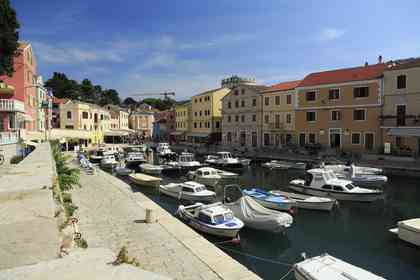
Header photograph: the inner harbour of Veli Lošinj, seen from the east shore near the church of Sveti Antun, 27 May 2018. Photograph by Falk2, Wikimedia Commons, CC BY-SA 4.0; resized and converted for web. Veli Lošinj was one of the two towns designated climatic health resorts in 1892.
Extended Read
For the measures behind the argument, from length of stay to local purchasing and pressure on housing and water, continue with Local Outcomes Define Higher-Value Tourism.
A longer Lefkada season starts in the mountain villages.
Further Reading
- Destination Management Plan for the Town of Mali Lošinj 2026 to 2029 (working draft, in Croatian)
- National Inventory of Intangible Cultural Heritage: Karsaniko embroidery, Karya
- INSETE: international tourism in the Ionian Islands, 2024 summary (in Greek)
References
- Institute for Tourism, Zagreb, for the Mali Lošinj Tourist Board, Plan upravljanja destinacijom Grad Mali Lošinj 2026.–2029. i izračun prihvatnog kapaciteta, working draft, April 2026: transport profile p. 8; TOMAS motives p. 10; operators and nights by type 2022 to 2024 p. 14; seasonality by type p. 15; capacity and star categories p. 16; occupancy p. 17; restaurants p. 21; TOMAS travel mode p. 23; climatic health resort history p. 27; year-round ferry links p. 39; labour supply p. 47; housing-affordability standard p. 173.
- Mali Lošinj Tourist Board, “Lošinj je prirodni laboratorij zdravlja”, report of the MEDISOLA opening conference, 2 October 2025.
- Lošinj Hotels & Villas, MEDISOLA at Hotel Bellevue, programme 2 to 26 October 2025; Mali Lošinj Tourist Board, MEDISOLA 2026 listing.
- Mali Lošinj Tourist Board, Hotel Bellevue listing, operating season March to November, checked 9 October 2026.
- KIGO.hr, “Otok vitalnosti ugostio najveći broj novogodišnjih gostiju do sada”, tourist board release, 3 January 2026.
- Turizam.media, “Na Lošinju živimo odgovorni turizam”, interview with Dalibor Cvitković, 13 October 2025.
- Hellenic Chamber of Hotels and ITEP, Hotel capacity 2025 by region, Ionian Islands table, Lefkada regional unit.
- INSETE Intelligence, “06 Ionian Islands”, international tourism 2023 and 2024.
- Aixmi Lefkadas, “Πακέτο έργων 12 εκατ. € για την πόλη της Λευκάδας”, 19 February 2026.
- Lefkas News, “Δήμος Λευκάδας: Φαρομανητά 2026”, municipal announcement of the 12 to 22 February 2026 programme, 23 January 2026.
- Virus.com.gr, “Στέγαση υγειονομικών στη Λευκάδα σε κρίση”, 3 November 2025.
- Aixmi Lefkadas, “Το ‘Αβέρωφ’ ανακαινίζεται και θα δοθεί για την στέγαση γιατρών”, 30 October 2025.
- National Inventory of Intangible Cultural Heritage of Greece, “Καρσάνικο Κέντημα”, dossier sections 6 to 8.
- European Commission, Commission Implementing Regulation (EU) 2023/2893, Faki Eglouvis PDO; single document, 30 August 2023.
- Karsanika Nea, press release of MP Thanasis Kavvadas on water tanks in Karya, Pigadisanoi and Meganisi, 16 January 2025.
- Epirus Online, “«Παιχνίδια συμφερόντων» με το νερό στη Λευκάδα”, 1 August 2025.
- Port City, “Εγκαίνια του καταφυγίου τουριστικών σκαφών στο Νυδρί”, 11 April 2025.
- Ypodomes, “Μελέτες για την επέκταση του καταφυγίου τουριστικών σκαφών και την ανάπλαση του παραλιακού μετώπου στο Νυδρί”, 14 April 2025.
- Municipality of Lefkada, Municipal Port Fund statement and chronology on the Nydri tourist-boat shelter, 28 July 2026.
- Prisma Radio, “Ρόδη Κράτσα για τουριστικό καταφύγιο Νυδριού: «Ακόμη δεν έχει άδεια λειτουργίας»”, 18 September 2026.
- Municipality of Lefkada, Start of works on the Nydri seafront road in the port land zone, 9 February 2026.
- Falk2, “J32 221 Veli Lošinj, Innenhafen”, 27 May 2018, CC BY-SA 4.0.
More from the journal
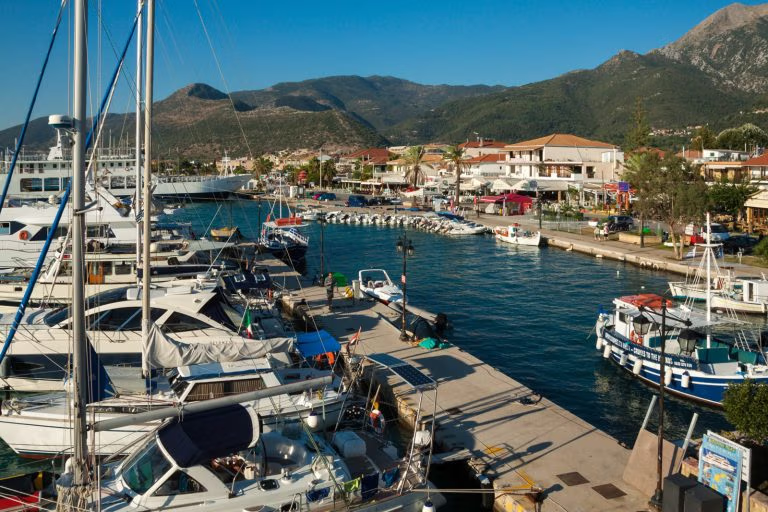
Nydri After Summer: Buses Keep Running, but Boats and Opening Hours Need Dated Checks
Resident infrastructure, dated services and the checks that cannot be skipped
Slow Travel Through Lefkada’s Working Traditions
Tourism Beyond Volume: Evidence Standards for This Series
The questions and evidence standards for this tourism series