Theodoros Stamos and the Infinity Fields
The New York painter and the Lefkada Infinity Fields
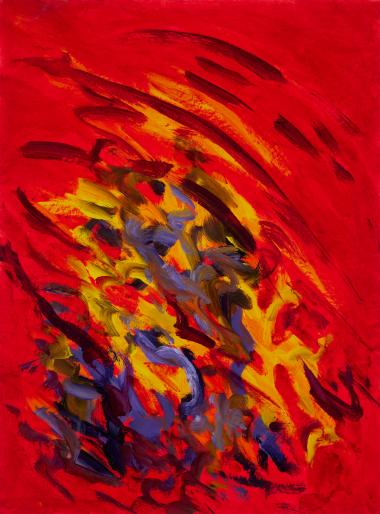
Theodoros Stamos used Lefkada as a recurring title and working context for the Infinity Field paintings he made from the early 1970s. Broad colour fields, narrow divisions and horizon-like lines define this mature work, produced while he divided his time between Lefkada and New York.
“My feeling was to create more infinity with color…”
Theodoros Stamos, as quoted in Infinity and Beyond, Hollis Taggart, 2008.
New York before the island
Stamos was born on Manhattan’s Lower East Side in 1922 to Greek immigrant parents. His father came from Lefkada, his mother from Sparta. At fourteen he won a scholarship to the American Artists School, where he first studied sculpture before turning to painting. He continued his education in galleries, museums and the frame shop where he worked among New York’s European avant-garde (Smithsonian Archives of American Art, n.d.; Goulandris Foundation, n.d.; Museum Reinhard Ernst, n.d.).
His rise was unusually quick. In 1943, aged twenty, he had his first solo exhibition at the Wakefield Gallery and Bookshop. The Museum of Modern Art acquired his 1946 painting Sounds in the Rock the following year.
Stamos’s early canvases were earthy and biomorphic, with forms that appear geological in one passage and cellular in another. Barnett Newman called this quality a communion with nature. Stamos described nature as a storehouse of ancestral memory.
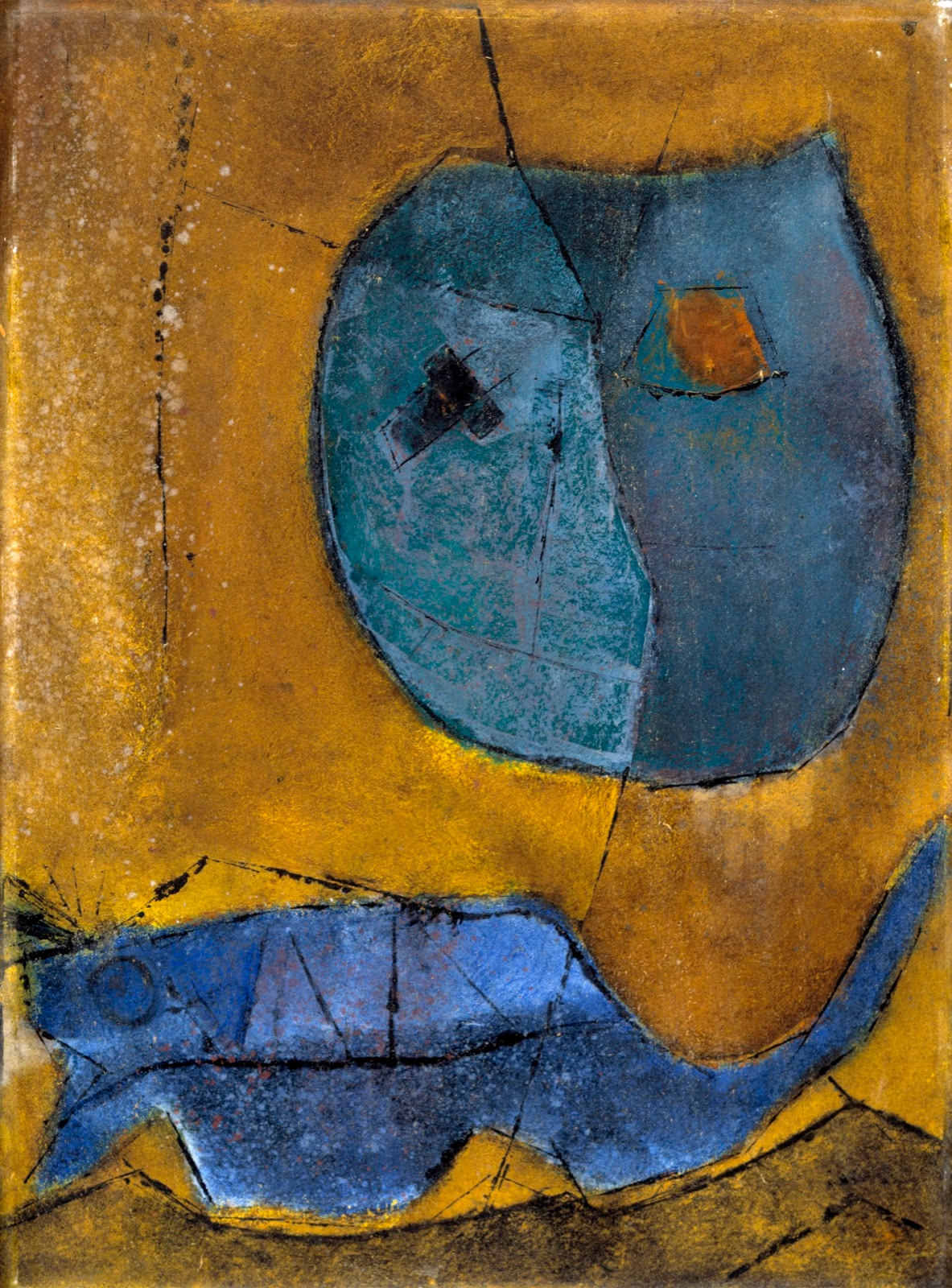
“The end of such a journey is the impulse of remembrance and the picture created is the embodiment of the Ancestral World…”
Statement by Theodoros Stamos in The Tiger’s Eye, 1947, quoted by Museum Reinhard Ernst.
The youngest Irascible
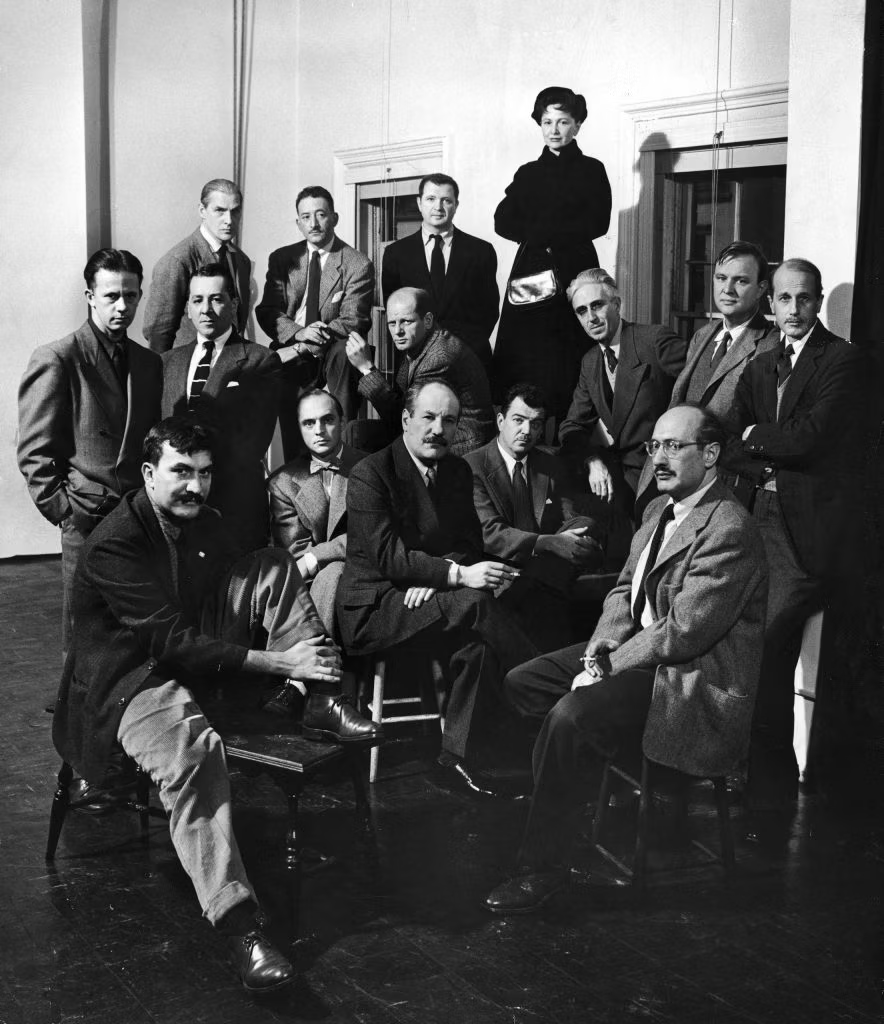
In 1950 Stamos joined seventeen other artists in signing a protest against the Metropolitan Museum of Art’s conservative treatment of contemporary American painting. The press called them the Irascibles. Fifteen signers sat for Nina Leen’s photograph in November 1950; Life published it the following January.
Stamos belonged to the first generation of Abstract Expressionism and exhibited with artists who made New York a centre of postwar modern art. His own work followed stone, water, botany, myth and the capacity of a painted surface to hold more than it described.
From Sun-Boxes to Infinity Fields
By the 1960s the organic shapes had tightened into the geometric architecture of the Sun-Boxes. Rectangles, bars and narrow divisions of colour carried the composition. In 1970 Stamos began the Infinity Fields, the body of work that would dominate his late career (National Gallery of Greece, n.d.).
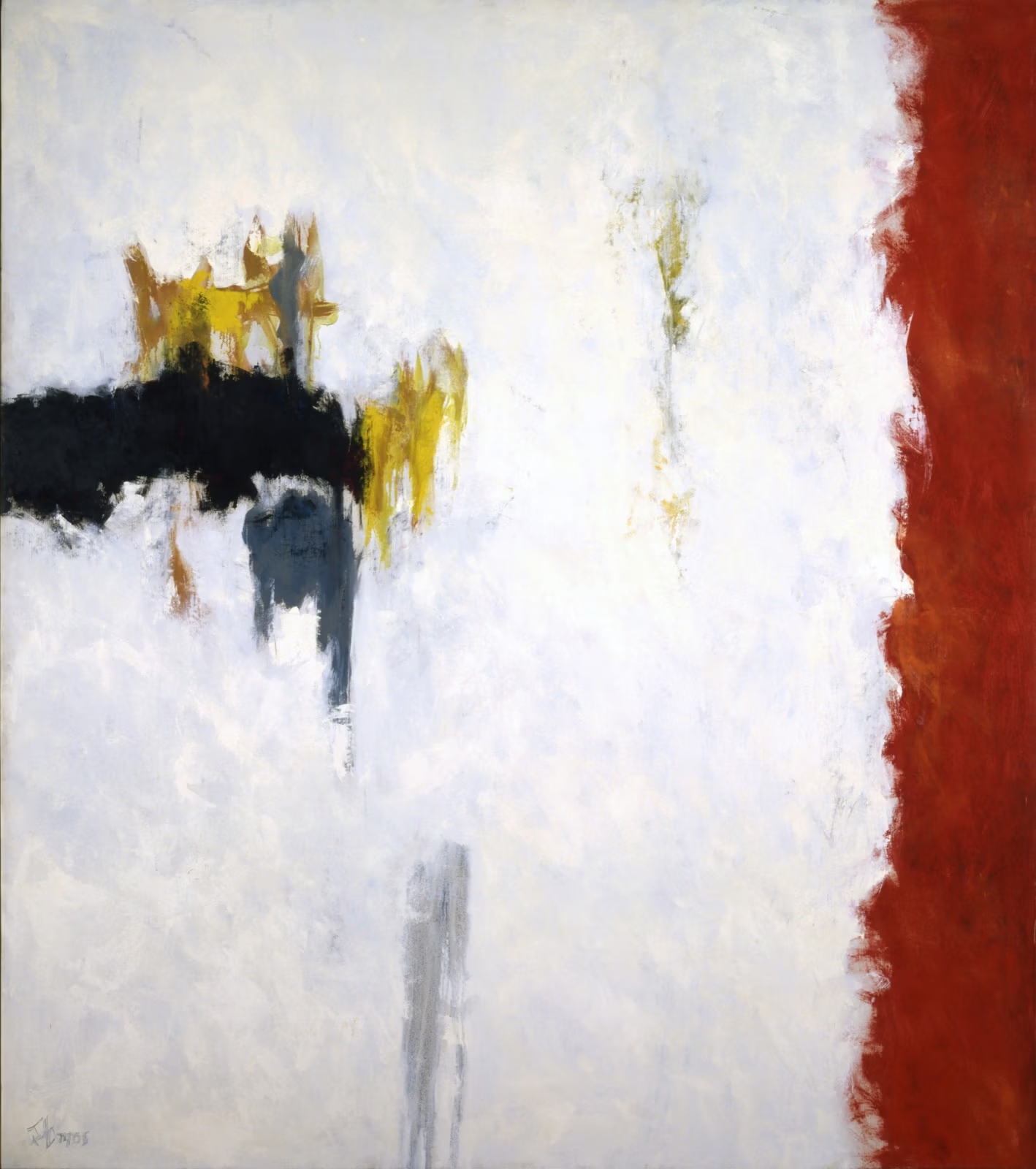
The later paintings retained fields and boundaries while loosening their edges. A horizon-like line divides one expanse from another; blocks of colour appear to continue beyond the canvas. Frayed edges and luminous surfaces make a finite canvas feel unbounded.
Stamos said in a 1954 lecture that an artist’s “highest effort” was “to suggest infinity, the infinity which belongs to the free mind of man.”
Quoted in Infinity and Beyond, Hollis Taggart, 2008.
Lefkada in the titles and studio
Beginning in 1970, Stamos divided his time between New York and Lefkada. Institutional accounts differ slightly on whether the settled rhythm began that year or after 1972. The first paintings explicitly titled Infinity Field, Lefkada Series are documented from 1972 onward (National Gallery of Greece, n.d.; Goulandris Foundation, n.d.).
Stamos described “a powerful and conscious relationship between my work and nature,” one that ultimately appeared as “a faceless expression” (Alpha Bank Art Collection, n.d.). That phrase places Lefkada within the conditions of the painting rather than its depicted subject.
Greek inheritance supplied Stamos with a structure of thought. The Smithsonian’s archival biography connects it to his interest in spiritualism, ancient Greek myth and philosophy. His studies also included Far Eastern philosophy and Japanese art and calligraphy. In the Lefkada paintings, ancestry, nature and a wider spiritual search converge in fields of colour (Smithsonian Archives of American Art, n.d.; National Gallery of Greece, n.d.).
The shadow over the work
Mark Rothko named Stamos one of the executors of his estate. Contracts made with Marlborough Gallery after Rothko’s death led to years of litigation.
In 1977 the New York Court of Appeals upheld findings that Stamos had acted under a conflict of interest and failed in his fiduciary duties. The case reshaped his reputation and came to overshadow accounts of his later work (Matter of Rothko, 1977; Smithsonian Archives of American Art, n.d.).
Stamos and Lefkada
Stamos died in Ioannina in 1997 and was buried on Lefkada at his request (Goulandris Foundation, n.d.; Smithsonian Archives of American Art, n.d.).
Further Reading
National Gallery of Greece. Stamos Theodoros. Follow the career chronology, from the biomorphic work and first Color Fields to the Sun-Boxes and Infinity Fields.
The Phillips Collection. World Tablet, 1948. Read the collection essay on Stamos’s early biomorphism, postwar regeneration and affinity with Arthur Dove.
The New American Painting, Museum of Modern Art, 1958–1959. Explore the exhibition that presented Stamos with sixteen other artists across eight European countries.
References
Alpha Bank Art Collection. (n.d.). Theodoros Stamos, Infinity Field (Lefkada). https://www.alphapolitismos.gr/en/art-collection/our-works-of-art/theodoros-stamos-infinite-field-lefkada-series/.
Basil and Elise Goulandris Foundation. (n.d.). Theodoros Stamos, Infinity Field – Lefkada Series, 1980. https://goulandris.gr/en/artwork/stamos-theodoros-infinity-field-lefkada-series-1980.
Hollis Taggart. (2008). Theodoros Stamos: Infinity and Beyond. https://www.hollistaggart.com/exhibitions/84-theodoros-stamos-infinity-and-beyond/.
Matter of Rothko, 43 N.Y.2d 305 (New York Court of Appeals, 1977). https://www.nycourts.gov/reporter/archives/rothko.htm.
Metropolitan Museum of Art. (n.d.). Abstract Expressionism. https://www.metmuseum.org/essays/abstract-expressionism.
Museum Reinhard Ernst. (n.d.). Home of the Sun. https://www.museum-re.de/en/art/reinhard-ernst-collection/objects/home-of-the-sun/.
The New American Painting as Shown in Eight European Countries. Museum of Modern Art. (1959). https://www.moma.org/calendar/exhibitions/1990.
Theodoros Stamos, Sounds in the Rock, 1946. Museum of Modern Art. (n.d.). https://www.moma.org/collection/works/78519.
National Gallery – Alexandros Soutsos Museum. (n.d.). Stamos Theodoros. https://www.nationalgallery.gr/en/artist/stamos-theodoros/.
National Portrait Gallery, Smithsonian Institution. (n.d.). The Irascibles. https://npg.si.edu/object/npg_EXH.AN.6.
The Phillips Collection. (n.d.). Theodoros Stamos, World Tablet, 1948. https://www.phillipscollection.org/collection/world-tablet.
SearchCulture.gr. (n.d.). Stamos Theodoros, 1922-1997. https://www.searchculture.gr/aggregator/persons/168846984?language=en.
Smithsonian American Art Museum. Theodoros Stamos: Untitled, 1946 and White Field VII, 1961. Both digital images are identified by the museum as public domain.
Smithsonian Archives of American Art. (n.d.). Theodoros Stamos papers, circa 1922-2008. https://www.aaa.si.edu/collections/theodoros-stamos-papers-8477/biographical-note.
More from the journal
Oiniades: Theatre, Ship Sheds, and a Harbour Now Inland
How naval architecture and the changing Acheloos delta preserve two halves of the same history
Andreas Kalvos: The twenty odes and a life in exile
The August Full Moon at Heritage Sites: A Western Greece Guide for 2026
Verified 2026 night openings and events at Nikopolis, Sami and Plevrona