Wilhelm Dörpfeld at Nydri: the royal graves that were older than Odysseus
“The plain of Nidri, in which, on the basis of Homer’s statements, I hoped to find the city of Odysseus and in fact also discovered it.”
Wilhelm Dörpfeld, Alt-Ithaka, 1927, p. 188 (Othisis translation)
Wilhelm Dörpfeld published that sentence in 1927, after more than a decade of digging in the plain behind Nydri. The 33 burial mounds he opened at Steno, which he called royal graves, are now dated to 2600 to 2200 BC, far earlier than any king in Homer. Dörpfeld himself is buried at Vlychos, on the same bay.
An excavation architect from Olympia and Troy
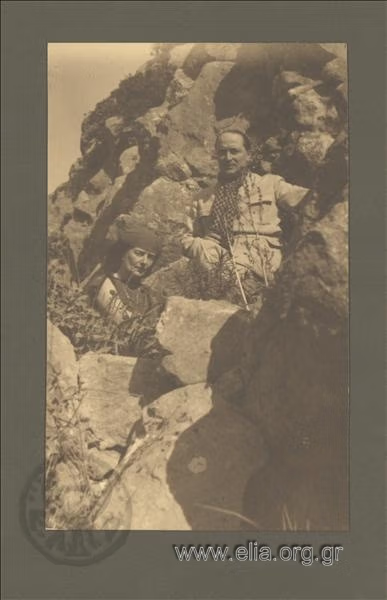
Dörpfeld was trained as an architect, and he came to Lefkada with a reputation for exact digging. Born in Barmen on 26 December 1853, he trained at the Berlin Bauakademie from 1873 to 1876 and was sent to the German excavations at Olympia in 1877. He then worked with Heinrich Schliemann at Troy and continued the excavations there after Schliemann died in 1890. He led the German Archaeological Institute in Athens for 25 years, as its First Secretary, and retired in 1912 (Neue Deutsche Biographie).
The same entry calls him the most successful excavator of his time. After retiring in 1912 he dug on Leukas, where he placed Homer’s Ithaca, and argued his theories in public with their opponents.
Three floors of settlement under the Nydri plain
Dörpfeld read the Nydri plain by layers. In the results chapter of Alt-Ithaka he reports three levels of settlement across almost the whole plain. The top floor held Roman and some Byzantine sherds. Below it lay a humus layer he called the Greek or Dorian floor, which he dated from the Dorian arrival at the end of the second millennium BC. The oldest level was the one he wanted: in his reading, the city of Odysseus.
The chapter lists what the trenches produced in the plain: water works, houses, sanctuaries, two family graves, several single graves and “many royal graves”. The royal graves are the part of his work that later study changed most.
Thirty-three mounds at Steno, dated 2600 to 2200 BC
The Ephorate of Antiquities of Aetolia-Acarnania and Lefkada now dates the Steno cemetery to the Early Helladic II period, 2600 to 2200 BC. Its site record says Dörpfeld took the tombs for royal burials connected with his Homeric Ithaca, and that they belong to an entirely different age. It counts 33 adjoining mounds, known as the R-grave cemetery, and notes that more mounds were probably never excavated.
Each mound had a built circular wall between 2.70 and 9.60 metres across, filled with earth and pebbles to a height of about 60 centimetres. A central burial, usually of an adult, was joined by secondary burials of the same family inside and outside the ring. The dead were both buried and cremated. Some principal burials carried weapons and jewellery of precious materials, which the Ephorate reads as a sign of social difference within the community.
The Ephorate links the mounds to cultures in Sardinia and the western Balkans. In 2005 Imma Kilian-Dirlmeier re-examined Dörpfeld’s records and finds from 1903 to 1913. Her study of the Nidri graves argues for close Early Bronze Age ties with the Cyclades and the Balkans, and for a trading role at Nidri. Dörpfeld had the right graves in the wrong millennium.
Finds in Lefkada and Athens, mounds by the Vasiliki road
Part of the Steno material is on display in the fourth room of the Archaeological Museum of Lefkada. The precious jewellery is in the National Archaeological Museum in Athens. Between 2011 and 2014 the cemetery was conserved and laid out for visitors under an ESPA project with a budget of €370,000. The site lies on both sides of the provincial road from Nydri to Vasiliki and is open by arrangement with the Ephorate, without a ticket.
A grave across the water from Nydri harbour
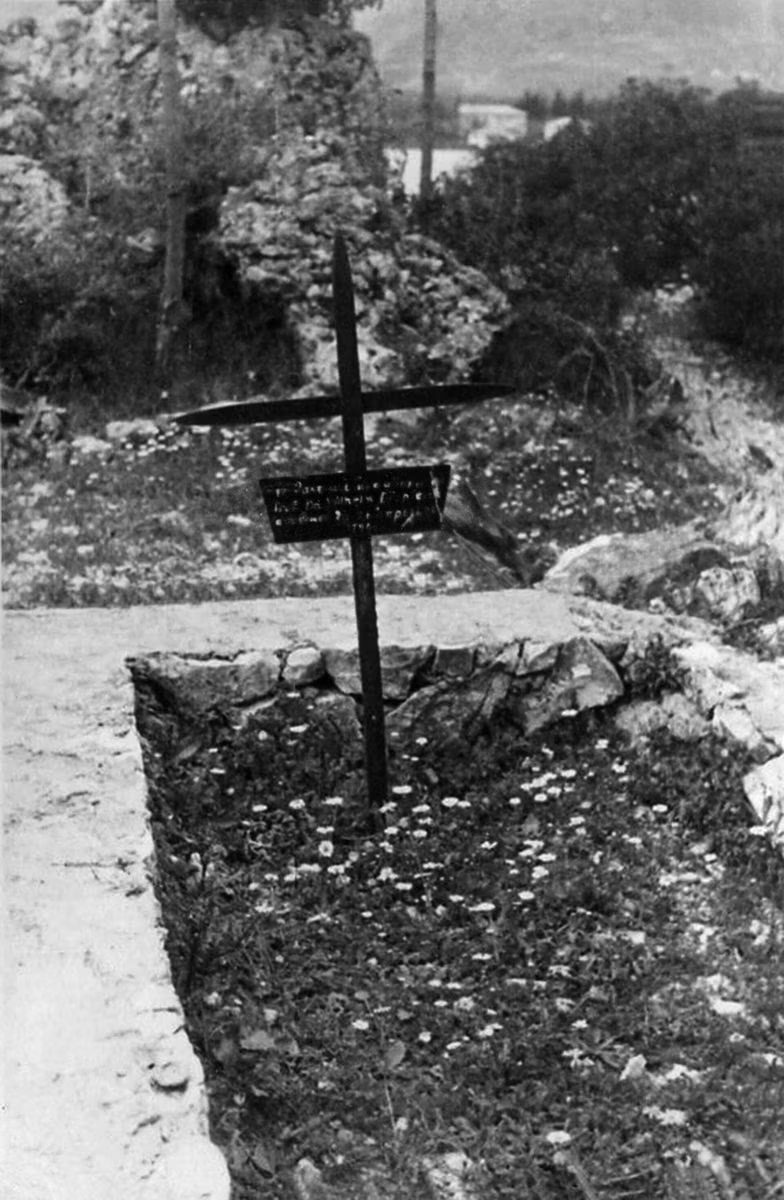
Dörpfeld died at Nidri on 25 April 1940 (Neue Deutsche Biographie). A photograph taken by an unknown German visitor in December 1943, now in the Actia Nicopolis Foundation collection in Preveza, shows the tomb at Vlychos three years after the burial. The Ephorate places the Steno cemetery near the same bay of Vlychos. The man who dug the plain for Odysseus is buried close to the graves he misdated by more than a thousand years.
Featured image: The tomb of Wilhelm Dörpfeld at Vlychos, Nydri, photographed by an unknown visitor in December 1943. Actia Nicopolis Foundation, Preveza, Nikos D. Karabelas collection (IAN F3212), via Wikimedia Commons. CC BY 4.0 (anonymous work). Resized for web.
Extended Read
For the Homeric case itself, and why it remains disputed, continue with The Odyssey and the Lefkada Question.
Further Reading
- Kilian-Dirlmeier, Imma. Die bronzezeitlichen Gräber bei Nidri auf Leukas (Propylaeum open-access edition).
References
- Dörpfeld, Wilhelm, with Peter Goessler (ed.). Alt-Ithaka: ein Beitrag zur Homer-Frage, vol. 1, section V, p. 188. German original of the opening quotation: “Die Ebene von Nidri, in der ich auf Grund der Angaben Homers die Stadt des Odysseus zu finden hoffte und tatsächlich auch entdeckt habe.” Munich-Gräfelfing, 1927. Heidelberg University Library digital edition.
- Ephorate of Antiquities of Aetolia-Acarnania and Lefkada. Prehistoric tumuli at Steno, Lefkada (site record, in Greek). Accessed 16 October 2026.
- Kilian-Dirlmeier, Imma. Die bronzezeitlichen Gräber bei Nidri auf Leukas: Ausgrabungen von W. Dörpfeld 1903 bis 1913. Monographien des RGZM 62. Mainz, 2005.
- Gottfried von Lücken, “Dörpfeld, Friedrich Wilhelm”, Neue Deutsche Biographie 4 (1959), pp. 35 and 36, online edition. Accessed 16 October 2026.
- The tomb of Wilhelm Dörpfeld, December 1943, Actia Nicopolis Foundation (IAN F3212), Wikimedia Commons.