Eco-Gozo promised an ecological island by 2020; Gozo now has a statutory ten-year strategy
In 2008, Malta’s government launched Eco-Gozo with the ambition of making Gozo an ecological island by 2020. The programme produced an action plan and funded local projects, but publication of its long-term vision became a political dispute. Gozo now has a regional strategy for 2023 to 2033, and in September 2026 two public authorities signed an agreement to begin implementing a climate-neutrality plan.
Eco-Gozo began with public consultation
The Ministry for Gozo’s 2012 booklet describes a consultation launched in 2008 whose proposals helped shape the 2010 to 2012 action plan. Its remit extended beyond environmental protection to the economy, society, culture and identity.
The first plan contained 82 recommendations. The booklet reported that 61 were either completed or at various stages of completion, a broader category than finished projects. The ministry’s annual report for 2012 records practical work under Eco-Gozo, including seven reservoirs with more than 1,350 cubic metres of storage and five kilometres of restored rubble walls.
The vision document was delayed in 2012
MaltaToday reported on 8 May 2012 that the promised Eco-Gozo 2020 vision document had not been tabled in Parliament. The ministry said it was updating the document; opposition MP Leo Brincat pressed for publication. The report also set out the gap between the €25 million announced for three years in the 2010 Budget and actual spending of €1,441,723 in 2010. It listed budget estimates of €6 million for 2011 and €4 million for 2012, with the remaining allocation due in 2013.
In August 2012, the ministry opened a new consultation for the 2013 to 2015 action plan. Its annual report describes A Vision for an Eco-Island as a synthesis of the earlier consultation, published to help select the next priorities. The 2012 booklet invited residents to contribute again.
A statutory authority drew up the 2023 to 2033 strategy
The Gozo Regional Development Authority was established under Act XVIII of 2019, Chapter 600, with responsibility for drawing up a regional strategy and overseeing implementation. Its September 2023 strategy followed a consultation begun in July 2021, involving public meetings, working groups and more than 350 ideas and proposals.
The strategy calls for a fresh assessment of pressures on Gozo’s infrastructure and natural resources. It also asks for the proposed Malta–Gozo tunnel to be reconsidered in light of improved ferry connections and the air link then under consideration. These were proposals in the 2023 document.
A climate-neutrality agreement followed in September 2026
The GRDA held a public consultation from 11 March to 1 April 2026 on a climate-neutrality plan. Its brief included an energy baseline, alternative scenarios, a viable target date and the measures and financing needed to reach it.
On 25 September 2026, the GRDA and Malta’s Climate Action Authority signed a memorandum of understanding at the Gozo Towards Climate Neutrality conference. The Ministry for Gozo announced that the plan had been published and that the agreement would support its implementation within the regional strategy. The next step identified by the ministry was for government and the responsible authorities to turn the plan into concrete measures.
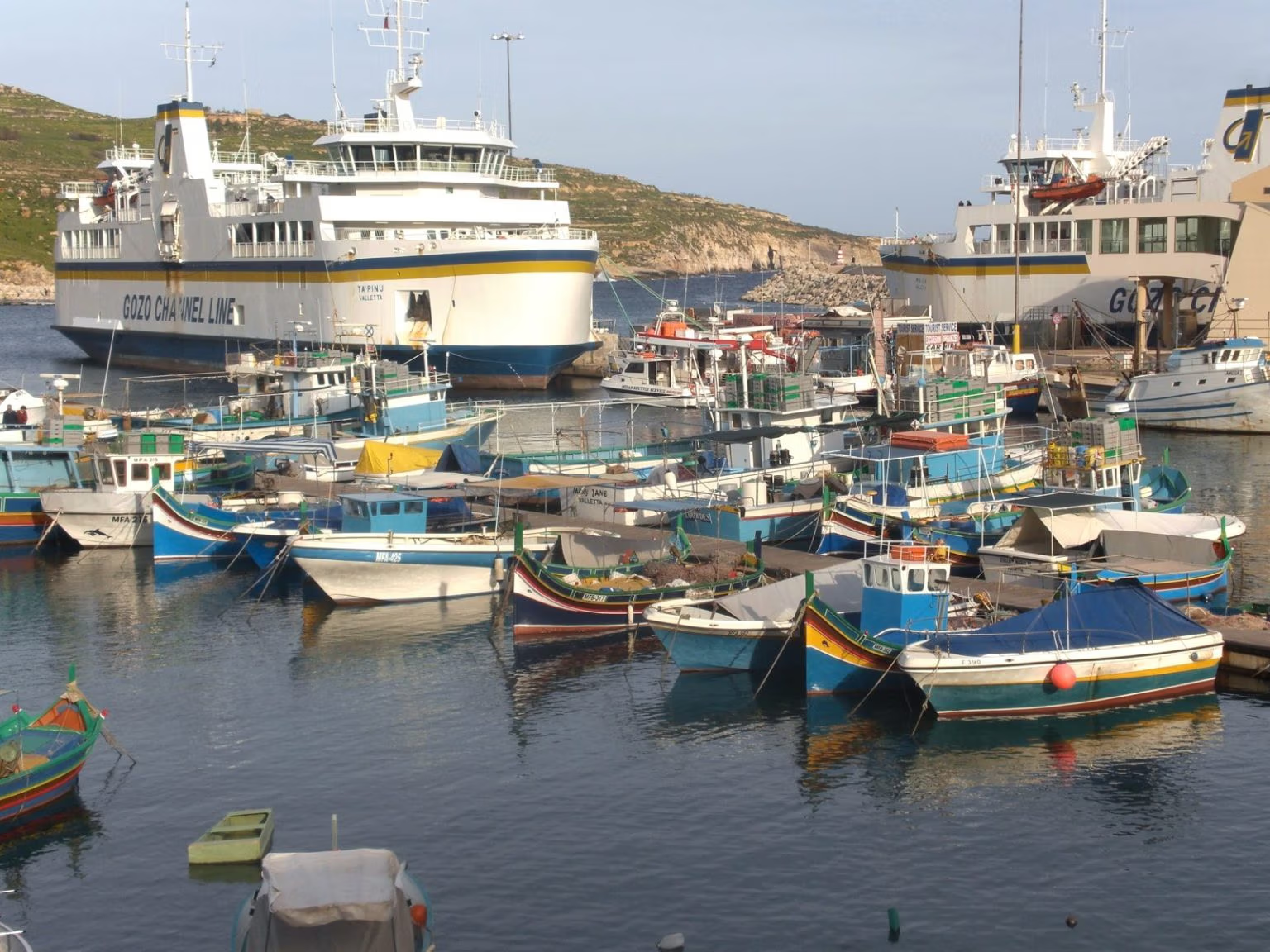
Featured image: the ferry Ta’ Pinu at Mġarr Harbour, Gozo, February 2009. Photograph by KarstenDD, via Wikimedia Commons, public domain (released by the author). Resized for web.
References
- Ministry for Gozo, A Vision for an Eco-Island, 2012.
- Ministry for Gozo, Annual Report 2012.
- Miriam Dalli, MaltaToday, 8 May 2012.
- GRDA, The Gozo Regional Development Strategy, September 2023.
- GRDA, Gozo Climate Neutral Plan consultation, March to April 2026.
- Ministry for Gozo, press release PR261556, 25 September 2026.