Faki Eglouvis PDO: Place, Crop and Production Chain
The European Union registered Faki Eglouvis as a Protected Designation of Origin in December 2023. The specification covers a local lentil population, its production area, seed selection, cultivation and packaging. A widely reported longevity study instead examines a Mediterranean dietary pattern among American women.
The registered name
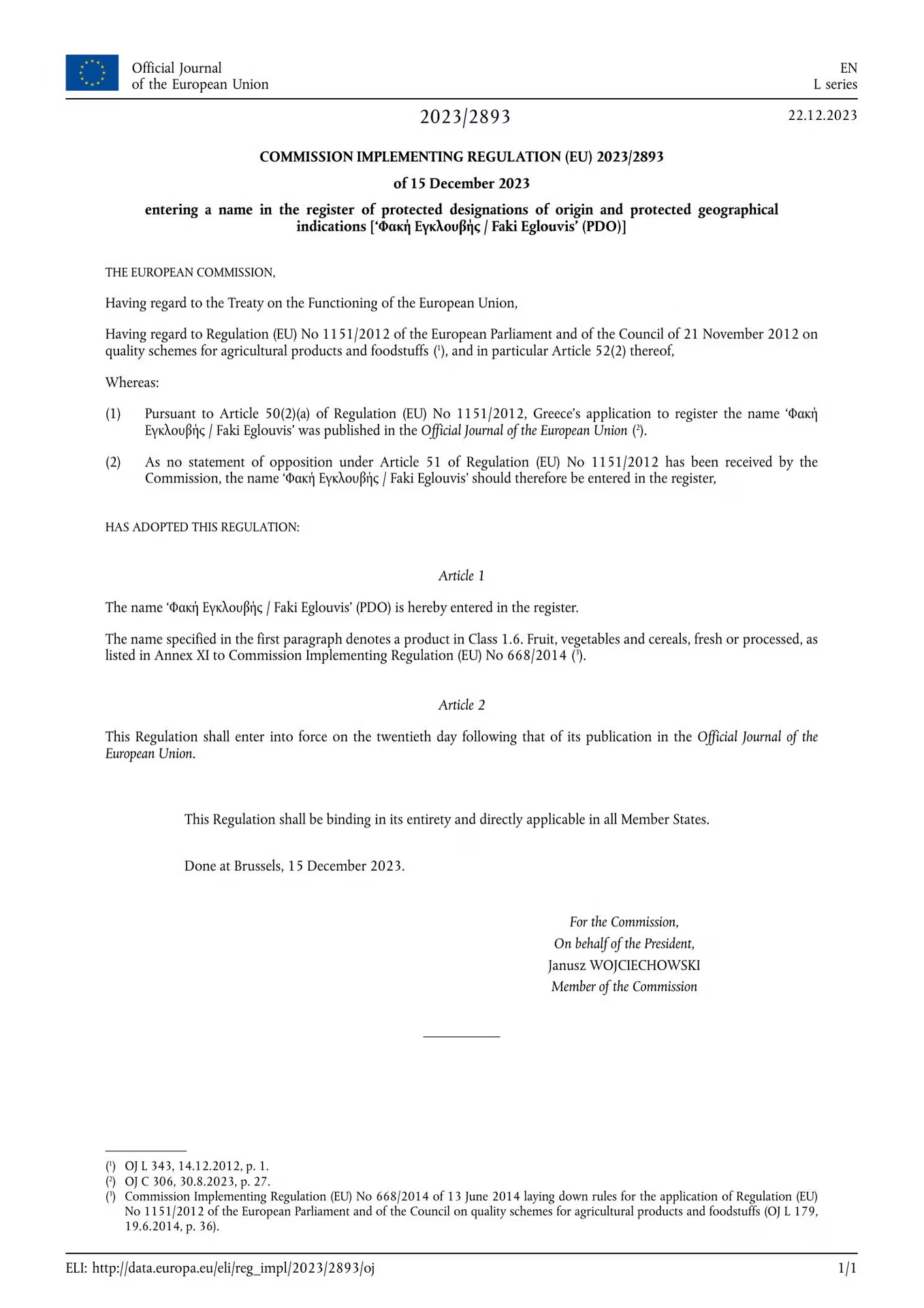
Commission Implementing Regulation 2023/2893 entered “Φακή Εγκλουβής / Faki Eglouvis” in the EU register. The regulation took effect after Greece’s application was published and no opposition was received.
The protected product is the seed of a local lentil population cultivated on the Englouvi plateau. The specification describes small seeds with a smooth surface, less flattening than many other lentils, and frequent dark spots or mottling. Those physical features identify the seed type; origin still requires label and traceability records.
A defined place and production chain
The designated area is the municipal district of Englouvi in the municipal unit of Karya. The specification places cultivation on a plateau around 750 to 950 metres above sea level, below the high interior of Elati.
Sowing normally begins in January and harvest takes place in June. The crop is generally rainfed. The specification identifies rainfall and west to north-west winds from mid-April to late May as important to fertilisation and yield.
Protection extends through the production chain. Seed is selected within the area from the previous harvest. Production, cleaning, sorting and packaging must remain within the defined zone. Packaging there protects traceability and reduces the risk of mixing the small local seed with other lentils.
The PDO evidence
PDO establishes that a registered name belongs to a product whose characteristics and production are tied to a defined place under an approved specification. For Faki Eglouvis, that record includes the local seed population, the Englouvi production zone and the stages that must occur there.
The designation gives a reader a testable question: does the product using the name meet the registered specification and traceability rules? Lentils outside that documented chain fall outside the designation.
Limits of the designation
Restaurants, recipes, organic methods and sustainability results require their own evidence. Product traceability comes from registered labelling and supply records; a menu description alone cannot establish it.
Health outcomes require clinical or dietary evidence. The PDO specification documents the product, its origin and the production stages tied to Englouvi.
Reading the 23 per cent longevity figure
A 2024 cohort study followed 25,315 initially healthy American women for about 25 years. Women with the highest Mediterranean-diet scores had a 23 per cent lower relative risk of death than women with the lowest scores in the paper’s principal comparison. The study reports an association; its observational design does not establish causation.
The score combined nine dietary components. Legumes were one component alongside vegetables, fruit, nuts, whole grains, fish, fat balance, lower red and processed meat intake, and a defined range of alcohol consumption. Lentils, Greece, Lefkada and Englouvi were outside the study’s separate measures.
The participants were mostly white, middle-aged or older female health professionals in the United States. Questionnaire reporting and residual confounding limit the result. The paper supports an inference about a dietary pattern within that population.
Extended Read
For the villages and the practical limits of an off-season visit, read Karya and Englouvi Outside Summer.
Further Reading
- EU registration of Faki Eglouvis PDO.
- Mediterranean Diet Adherence and Risk of All-Cause Mortality in Women, JAMA Network Open, 2024.
References
- European Commission, Commission Implementing Regulation (EU) 2023/2893, 15 December 2023.
- European Commission, single document for Faki Eglouvis, Official Journal of the European Union, 30 August 2023.
- European Commission Representation in Greece, “Faki Eglouvis added to the PDO register”, 19 December 2023.
- Shafqat Ahmad et al., “Mediterranean Diet Adherence and Risk of All-Cause Mortality in Women”, JAMA Network Open 7, no. 5 (2024): e2414322.
- Tomisti, “Elati or Stavrota mountain, Lefkada, view from the east”, 2016, CC BY-SA 4.0.