Lefkada’s Lost Theatre: How the Ionian Islands’ Only Ancient Stage Came Back Out of the Olive Groves
“For the find to be fully uncovered and opened to visitors, political, financial and archaeological continuity is hoped for […], provided they all coordinate, the bureaucracy is overcome and money is found.”
Athens Voice, 21 January 2016, on the confirmation of the ancient theatre of Lefkada (Othisis translation)
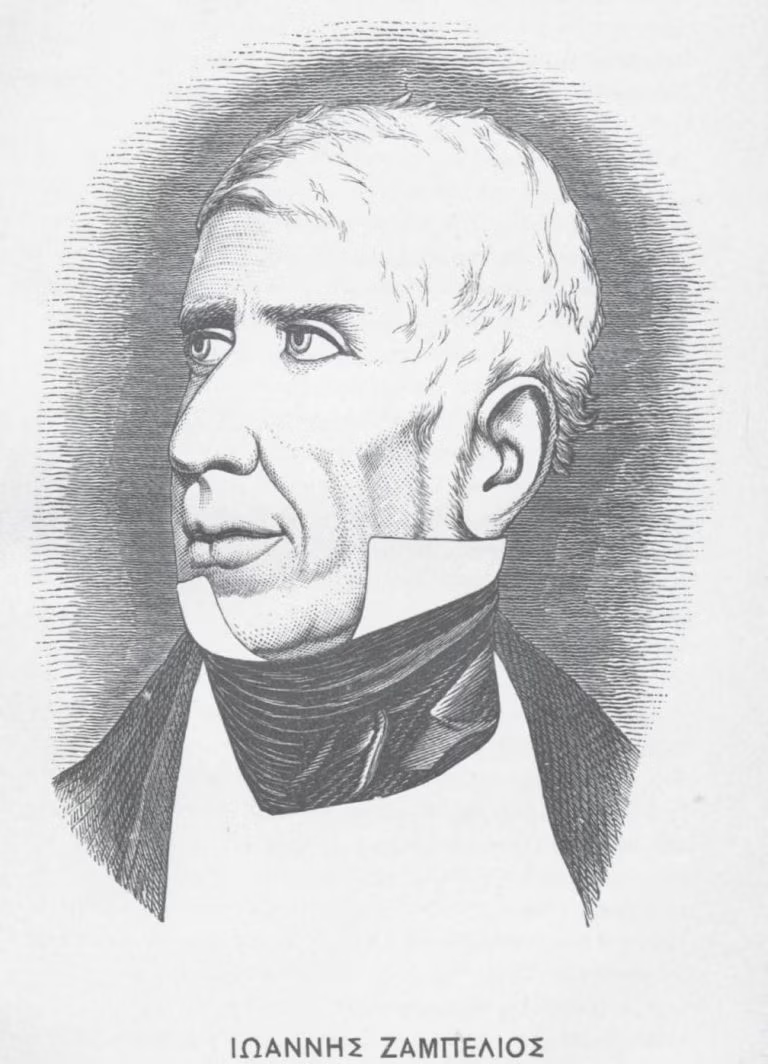
In 1901 E. Kruger, Dörpfeld’s collaborator, dug test trenches on Koulmos hill, south of Lefkada town. The trenches were refilled, and olive groves and storehouses hid the site until it was lost. The theatre recovered there is the only ancient one yet found in the Ionian Islands. In the fourth century BC a prosperous Leukas built 24 rows for about 3,500 people.
The Ministry estimates that the full plan, with an upper tier probably never finished, would have held 10,000 to 11,000. A landowner, a municipality, a region and the Ministry each paid or pushed to bring it back.
Kruger’s trenches and a site lost under olives
Kruger’s 1901 trenches were part of Dörpfeld’s fieldwork on Lefkada. Dörpfeld was arguing that the island was Homeric Ithaca, a case Othisis follows in The Odyssey and the Lefkada Question. According to the Ministry of Culture, what little was known about the theatre until 2015 came from those trenches, as recorded in Dörpfeld’s Alt-Ithaka. Athens Voice gave a slightly different account in 2016: the dig was never published as such, and its traces of a theatre survived in excavation diaries and drawings.
When the work ended, the trenches were backfilled. Over the following decades the slope was covered entirely by olive groves and makeshift storehouses, and the location of the theatre was forgotten. In 1997 the 12th Ephorate of Prehistoric and Classical Antiquities, then responsible for Lefkada, found the site again from the shape of the ground and ancient remains visible on the surface. Knowing where the theatre lay was one problem solved. Taking the olive trees off it was another, and that required money and land.
Two €100,000 grants and a landowner’s consent opened the dig
Coordinated efforts towards an excavation began in 2015 under Dr Olympia Vikatou, then head of the Ephorate of Antiquities of Aetolia-Acarnania and Lefkada. The Ministry credits their success to cooperation with the mayor of the time, Konstantinos Drakontaeidis, and to support from the DIAZOMA association. The municipality paid for the first test trenches. Athens Voice counted 13 of them in late 2015; they found rows of seats, the orchestra and the retaining wall of the stage.
Systematic excavation started in 2017 under a programme contract with the Ministry of Culture. The Region of the Ionian Islands contributed €100,000 and the Municipality of Lefkada another €100,000. Digging began on the land of Nikos Mikronis, the landowner, who agreed to let the work start before the expropriation procedure was complete.
Five seasons, ending in 2023, exposed most of the monument. The team removed many large olive trees, cleared extensive fill, dismantled modern structures and moved numerous architectural blocks. Besides Vikatou, the Ministry names archaeologists Vivian Staikou and Varvara Gkiza, surveyor Georgios Lolos, architect Nikos Chatzidakis and conservator Afroditi Tiligada. What they uncovered was a building planned on a larger scale than it was finished.
The building on Koulmos
The theatre lies on the north-east slope of the middle hill of Koulmos, about 3 kilometres south of Lefkada town, looking over the channel and the coastal plain where the ancient city spread. It is set on a north-east to south-west axis. Thirteen stairways, each 0.72 to 0.78 metres wide, divide the seating into 12 wedges.
The main theatre has 21 rows, and above the 21st there was probably a horizontal walkway, the diazoma. Higher still, three rows are cut into the rock; beyond them the rock of the upper tier is dressed to a single, even slope. The Ministry concludes that this upper tier was probably never completed. The 24 rows held about 3,500 spectators, and a completed upper tier would have raised the total to about 10,000 to 11,000.
The lowest part of the cavea survives best, especially at the centre, where limestone seat covers, stair treads and walkway slabs are still in place. The seats of honour are pairs of joined chairs, each pair 2.60 metres long. The orchestra is a full circle with an outer diameter of 16.65 metres, partly cut into the bedrock and framed by three courses of moulded stone. Around it, at a lower level, runs a carefully built drainage channel, the euripos, so far only partly excavated.
Fragments of three stone thrones are the most elaborate finds. Their carving includes lion’s feet, dolphins, birds and a siren. In the Ministry’s reading they were made for prominent figures, priests or officials of the city, and later of the Acarnanian League.
The stage building, 20 metres long and about 13 metres wide, survives only at the foundation level of its stylobate. Sandstone column fragments and pieces of the architrave allow the excavators to reconstruct an Ionic front of 16 pillars with engaged half-columns. Ramps 9 metres long climbed on either side to the logeion, the roof of that colonnade, where the actors appeared. Gates closed the side passages where each ramp began.
Leukas dressed its hillside for roughly three times the audience it seated
Corinthian settlers founded Leukas before the end of the seventh century BC at the north-east tip of the island. Its harbour and its position on the sea routes north and west made it wealthy, in the Ministry’s account. Rescue excavations have exposed parts of its walls, houses, cemeteries and harbour. The Ministry calls the theatre the most imposing monument yet uncovered at ancient Leukas and the first theatre in the Ionian Islands. In October 2026 Lefkada’s MP called it the only ancient theatre uncovered in the Ionian Islands so far.
The Ministry dates the start of construction to the fourth century BC, when the prosperous city was raising other public buildings; construction details point to later alterations. The rock above the diazoma shows how far the plan reached. Leukas dressed the hillside for roughly three times the audience its finished rows could hold. Athens Voice noted in 2016 that no ancient source mentions the theatre. The remains are the only record of that plan, and they give no reason for leaving the upper tier unfinished.
After Actium: decline and stone robbing
In the Roman period the theatre shared the decline of the city. When Octavian founded Nikopolis in 31 BC, a large part of the population of Leukas was forcibly settled in the new city, a foundation Othisis examines in Nikopolis After Actium. The theatre was probably abandoned after the end of antiquity. Much of its stone was carried off for later buildings, some of them built on the cavea itself, and later cultivation of the slope did further damage. The upper part of the cavea is the worst preserved.
Approved studies and a planned funding line
The programme contract also paid for a restoration study, drawn up by Chatzidakis, and a stone conservation study. The Lefkada news site kolivas.de reported in June 2025 that the Studies Department of the Ministry’s Directorate for the Restoration of Ancient Monuments had approved both, with conditions.
Final application studies must wait until excavation and documentation of the whole monument are complete. Separate studies are still required for rainwater management and for the restoration of the stage building. The conditions also ban the superplasticiser Glenium 11 from the mortar used to join fragments of poros, sandstone and conglomerate, and ban glyphosate as a treatment for woody vegetation.
The excavation itself has a gap. In April 2025 the Ministry said the upper cavea and part of the stage would be investigated once the expropriations planned during Minister Lina Mendoni’s visit to Lefkada in 2020 were complete.
On 6 October 2026 Thanasis Kavvadas, MP for Lefkada and Deputy Minister of Rural Development and Food, reported on a meeting with Mendoni and Vikatou, now Secretary General of the Ministry of Culture. His statement attributes approval of the two studies to the Central Archaeological Council. It also says the Ministry plans, by the end of the year, to include the restoration and presentation of the theatre in the National Development Programme (ΕΠΑ) 2026–2030. It describes a plan and names no budget.
Athens Voice listed four parties in 2016: Ministry, Municipality, Region and Ephorate. Each has since paid, dug or signed off. The part of Koulmos still unresolved is the upper slope. The builders of Leukas probably never finished its seating, and in April 2025 the Ministry was still waiting for the land in order to dig it.
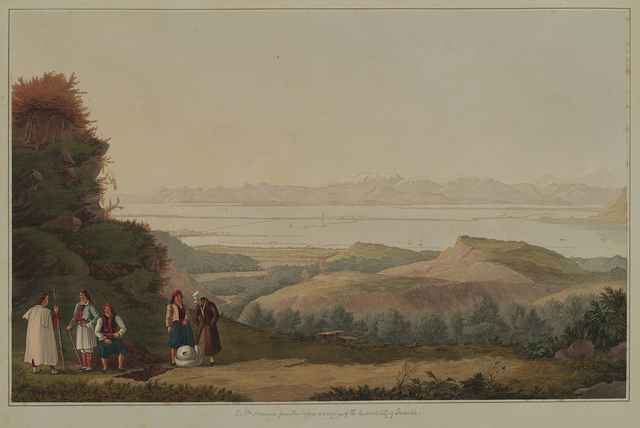
Header illustration: Joseph Cartwright, Santa Maura, from the Upper Acropolis of the Ancient City of Leucadia, coloured aquatint from Views in the Ionian Islands, 1821, via Wikimedia Commons. Public domain. The view looks over the town from the acropolis of ancient Leukas, the city that built the theatre on Koulmos.
Extended Read
Oiniades: Theatre, Ship Sheds, and a Harbour Now Inland.
Further Reading
- The Ministry of Culture’s account of the identification and excavation of the theatre (in Greek), with plans and photographs.
- The 2024 English-language summary in the Chronique des fouilles / Archaeology in Greece Online.
- Wilhelm Dörpfeld, Alt-Ithaka, volume one (1927), Heidelberg University Library.
References
- Hellenic Ministry of Culture. “Ο εντοπισμός και η συστηματική ανασκαφή του αρχαίου θεάτρου της Λευκάδας.” Press release, 2 April 2025. Accessed 9 October 2026.
- Mouratidis, Georgios. “Lefkada, Ancient Theatre – 2024.” Chronique des fouilles en ligne / Archaeology in Greece Online, report 20721. Accessed 9 October 2026.
- Athens Voice. “Οριστικό: Βρέθηκε το αρχαίο θέατρο της Λευκάδας.” 21 January 2016. Accessed 9 October 2026.
- Λευκαδίτικα Νέα (kolivas.de). “Εγκρίθηκε από το ΥΠΠΟ η αρχιτεκτονική μελέτη αποκατάστασης του αρχαίου θεάτρου Λευκάδας.” 18 June 2025. Accessed 9 October 2026.
- ilefkada.gr. “Θανάσης Καββαδάς: Νέα επιπλέον χρηματοδότηση 645.000 ευρώ για σημαντικά μνημεία της Λευκάδας.” 6 October 2026. Accessed 9 October 2026.
- aromalefkadas.gr. “Νέα επιπλέον χρηματοδότηση 645.000 ευρώ για σημαντικά μνημεία της Λευκάδας.” October 2026. Accessed 9 October 2026.
- Dörpfeld, Wilhelm. Alt-Ithaka: ein Beitrag zur Homer-Frage, volume one. Munich, 1927. Heidelberg University Library.